


1. Where is endometrium? 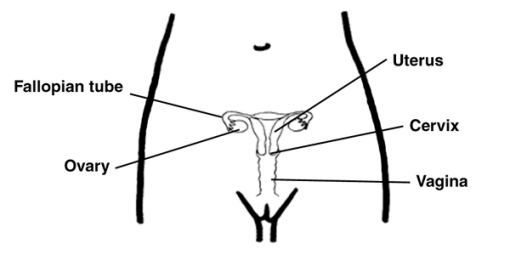 Endometrial cancer starts in endometrium which is the inner lining of uterus (womb).
2. How common is endometrial cancer?
Globally it is the sixth most common cancer in women, fourteenth most common overall. In year 2012 a total of 320,000 new cases were recorded. It is the most common gynaelogical cancer in developing countries, while in developed countries it is the second most common cancer, behind cervical cancer. It is the seventh most common cancer in women in Peninsular Malaysia, according to Malaysian cancer Registry 2006. It is rare among women younger than 40 years(3.6%) with peak incidence occurring at age 60-69. Majority are of Chinese ethnicity (47.5%), followed by Malays (41.6%) and Indian (10.9%).
3. What are the types of endometrial cancer?
Type 1: Related to estrogen, 75 to 85% of cases. Associated with better outcome.
Type 2: Not related to estrogen. Mostly high-grade tumor (Advanced stage). Associated with poorer outcome.
4. What are percentages of early detection?
Majority of cancer are noticed at early stages
● Primary site: 68% (Within the womb)
● Regional spread: 20% (to lymph nodes)
● Distant spread: 8% (to other parts)
5. Who are at risk?
● Woman who is obese (Strongest risk for both type 1 and 2. Increased estrogen production in the body)
● Woman who has not given birth before. (Women with type 2 usually have given birth)
● Woman with late menopause.
● Woman with diabetes mellitus.
● Prolonged exposure to estrogen.
● Usage of Tamoxifen, medication for prevention or treatment of breast cancer.
● Abnormal thickening of uterine wall.
● Inherited from family.
6. How do you know that this cancer is present?
90% have bleeding or discharge from vagina ONLY. Abnormal bleeding pattern aside from your period have to be taken seriously. Premenopause: Heavy menstruation or intermenstrual bleeding (3). Postmenopause: Abnormal vaginal bleeding or discharge (3).
7. How do we diagnose?
● Medical interview/consultation
● Physical examination
● PAP smear
● Transvaginal ultrasound
● Endometrial biopsy (Preferred. More sensitive)
● Hysteroscopy
● Dilatation and curettage
|
Transvaginal ultrasound |
Endometrial biopsy |
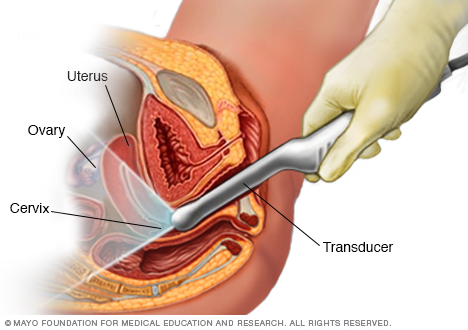
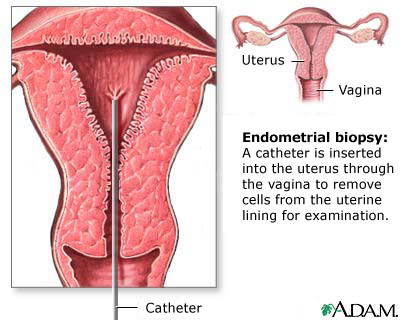
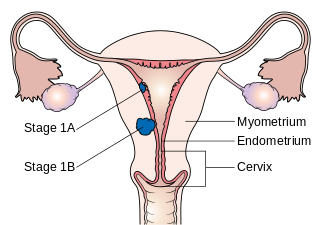
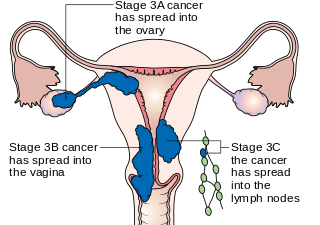
If endometrial cancer is diagnosed, the extent of the disease (stage) will need to be determined to plan its treatment. The various stages, according to FIGO staging is (3):
Stage 1 – Cancer is confined to the body of the uterus (corpus). 1A: <50% of uterus 1B: >50% of uterus
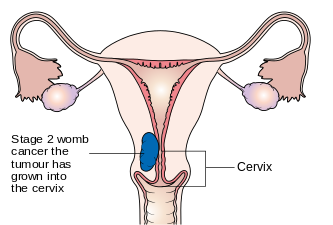
Stage 2 – Cancer has spread from the corpus to the cervix, but not beyond the uterus
Stage 3 – Cancer has spread out locally/regionally
3A: Tumor invades the serosa and/or adnexa
3B: Vaginal and/or parametrial involvement
3C: Spread to pelvic and/or paraaortic lymph nodes
- 3C1: Pelvic lymph nodes only
- 3C2: Pelvic and/or paraaortic lymph nodes
Stage 4 – Cancer has spread to the bladder and/or bowel mucosa, or beyond the pelvis to other parts of the body (distant metastasis)
4A: Tumor invades bladder and/or bowel mucosa
4B: Distant metastasis
 |
 |
 |
 |
Images from Cancer Research UK: http://www.cancerresearchuk.org/about-cancer/type/womb-cancer/treatment/stages-of-womb-cancer
9. What is the treatment?
There are different treatment options in endometrial cancer: surgery, radiotherapy, and hormone therapy. Some patients receive a combination of therapies. In most of the cases, surgery is needed.
10. What is the prognosis?
Overall, a 5-year survival rate in endometrial cancer is approximately 75%. It is highly curable if treated early! KEY POINTS
● Endometrial cancer is a disease in which malignant (cancer) cells form in the tissues of the endometrium (uterus).
● Obesity, high blood pressure, and diabetes mellitus may increase the risk of endometrial cancer.
● Taking tamoxifen for breast cancer or taking estrogen alone (without progesterone) can increase the risk of endometrial cancer.
● Signs and symptoms of endometrial cancer include unusual vaginal discharge or pain in the pelvis.
● Tests that examine the endometrium are used to detect (find) and diagnose endometrial cancer.
● Certain factors affect prognosis (chance of recovery) and treatment options.
References:
1. PlaxeSC , Mundt AJ. Overview of Endometrial Cancer. (Online) UpToDate. (Updated May 14 2015, Cited September 21 2015) Available from: http://www.uptodate.com.ezp.imu.edu.my/contents/overview-of-endometrial-carcinoma?source=search_result&search=endometrial+cancer&selectedTitle=2~150#H25012880
2. Berek J, Novak E. Berek & Novak’s gynecology. Philadelphia. Lippincott Williams & Wilkins; 2012.
3. Hoffman, Barbara, et al. Williams gynecology. McGraw Hill Professional, 2012.
4. Lum M. Cancer Malaysia, Oncology Malaysia Oncology, Oncologist & Cancer – Malaysian Oncological Society (MOS) [Internet]. Malaysiaoncology.org. 2015 [cited 21 September 2015]. Available from: http://www.malaysiaoncology.org/article.php?aid=297
Prepared by Lai Zhi Jun, Semester 9 Medic
al Student, International Medical University Lim Zi Xian, Semester 9 Medical Student, International Medical University Supervised by: Dr Kavitha Nagandla, Senior Lecturer, Dept of Obstetrics & Gynaecology, International Medical University
Thoughts Shared