



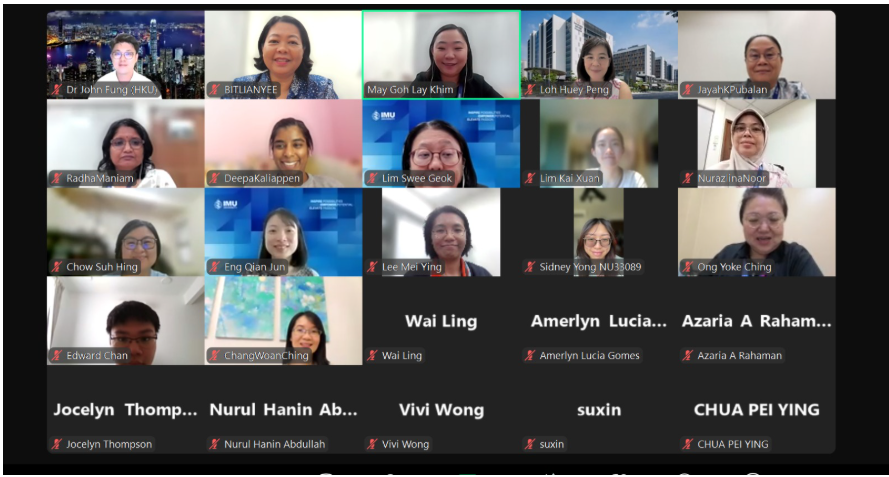
The Nurses’ Day Webinar – Nursing Symposium 2025 was organised by the Nursing Division in conjunction with IMU’s 33rd Anniversary and Nurses Day 2025. Held on 21 June 2025 from 9:00 AM to 1:00 PM via Zoom, the event carried the theme “Empowering the Nursing Workforce Towards a Resilient Healthcare System.” It was officiated by A/Prof Dr Kok Yih Yih, with the closing ceremony delivered by Dr Lim Swee Geok.

The Nurses’ Day Webinar – Nursing Symposium 2025 featured four insightful presentations, each addressing a unique facet of building resilience within the nursing profession.
The symposium opened with a session by Dr Lim Swee Geok, who emphasised the vital role of nurses in strengthening healthcare system resilience amid growing challenges. Following this, Dr Loh Huey Peng shared SingHealth’s strategic 5Cs framework as a comprehensive approach to fostering staff wellness and resilience in Singapore’s healthcare system. Eng Qian Jun then focused on self-care as a foundational practice for nurse empowerment, highlighting six key dimensions and urging a cultural shift to prioritise well-being without guilt.
Closing the series, Dr John Fung explored the integration of technology in nursing education, showcasing simulation-based learning and AI tools that prepare nurses to meet future healthcare challenges with competence and confidence.
Presentation by Dr Lim Swee Geok Emphasising on the Critical Role of Nurses in Enhancing Healthcare System Resilience
The symposium started with a presentation by Dr Lim Swee Geok. The presentation by Dr Lim Swee Geok emphasises the critical role of nurses in enhancing healthcare system resilience amongst rising complexities, workforce shortages, and technological advancements. It defines resilience at both individual and system levels, highlighting how leadership and professional development, such as emotional intelligence, crisis decision-making, and lifelong learning; are essential to building nurse resilience.
Dr Lim’s talk outlines strategies for cultivating nurse leaders through institutional support, policy reform, and academic-practice partnerships, with a focus on Malaysia’s nursing challenges and opportunities. Ultimately, she also strongly emphasised on advocates investing in nurses to strengthen both healthcare outcomes and national resilience.
Presentation by Dr Loh Huey Peng Outlining SingHealth's Strategic Approach to Empowering Nurses and a Resilient Workforce
The next presentation was by Dr Loh Huey Peng who outlined SingHealth’s strategic approach to empowering nurses and building a resilient healthcare workforce in Singapore. Emphasising the 5Cs framework: Connecting to Mental Wellbeing, Physical Wellbeing, Community, Career, and Culture; the initiative targets multi-level interventions to promote staff wellness. Strategies include psychological support systems, mental health stigma reduction, ergonomic workspaces, physical fitness activities, leadership engagement, and anti-harassment policies. The model integrates macro to micro-level applications and is supported by regular assessments such as wellness pulse surveys and employee engagement studies. These efforts aim to enhance resilience, reduce burnout, and retain nursing staff in an evolving healthcare landscape.
Presentation by Eng Qian Jun Highlighting the Critical Importance of Self-care
The presentation by Eng Qian Jun highlights the critical importance of self-care in empowering nurses and ensuring sustainable healthcare. Nurses often face burnout, compassion fatigue, and mental exhaustion due to chronic stress, particularly in high-stakes environments like ICUs. The presentation outlines six dimensions of self-care, namely physical, emotional, mental, social, professional, and spiritual. She emphasises activities such as mindfulness, journaling, rest, healthy boundaries, and peer support. It also addresses barriers like guilt, stigma, and time constraints, urging a shift in workplace culture to normalise self-care.
The key message is that self-care is not selfish but essential; when nurses care for themselves, they are better equipped to care for others. Leadership support and simple daily routines are crucial for fostering resilience and improving nurses’ overall well-being.
Dr John Fung’s Presentation on Technology and Adaptability Preparing Nurses for Future Healthcare Challenges
Dr John Fung’s presentation explores how technology and adaptability are essential in preparing nurses for future healthcare challenges. He highlights the integration of advanced simulation-based education (SBE), including high-fidelity manikins, virtual reality, and generative AI, to enhance experiential learning. These innovations support individualised feedback, realistic clinical scenarios, and asynchronous learning through AI-assisted debriefing.
Emphasis is placed on applying artificial intelligence (AI) in medical education, from image interpretation to clinical decision support, and in nurturing AI literacy among healthcare professionals. The use of AI tools (such as Med-PaLM and GenAI simulations) enables nursing students to interact with virtual patients, make diagnoses, and receive real-time performance feedback.
Dr Fung’s global collaborations demonstrate how AI-driven simulations improve clinical competence, cultural awareness, and digital readiness. The presentation highlights the importance of aligning educational strategies with modern technology to ensure nurses are well-equipped to meet evolving demands in healthcare delivery.
Q & A Session
Additionally, the Q&A session moderated by Goh Lay Khim was well addressed by all 4 panelists sharing experiences.
The 4 presentations collectively highlight the importance of resilience in leadership and clinical, self-care, and technological adaptability in empowering the nursing workforce.
Through strategic wellness frameworks, cultural shifts toward self-care, and the integration of AI and simulation-based learning, nurses are better equipped to thrive in a rapidly evolving healthcare landscape.
A total of eighteen participants completed the evaluation. Overall, the feedback provided ranged from good to excellent. All agreed that the event was well-prepared and organised.
Respondents noted that the symposium was highly informative and insightful. The majority expressed a strong interest in receiving information about future events.
Written by Yee Bit Lian, Symposium Chairperson
Edited by Dr Lim Swee Geok, Advisor
Thoughts Shared