


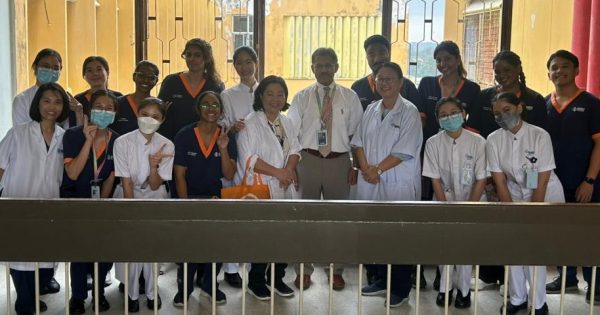
Interprofessional collaboration is a cornerstone of safe and effective healthcare. IMU University once again demonstrated this commitment through an Interprofessional Learning (IPL) session held on 23 and 25 July 2025 at the Orthopaedic Ward of Hospital Tuanku Ja’afar, Seremban. This collaborative initiative between the School of Medicine and the School of Health Sciences brought together Semester 8 Medical students (ME221) and Semester 4 Bachelor of Nursing students (NU123) in a meaningful exercise centred on patient care.
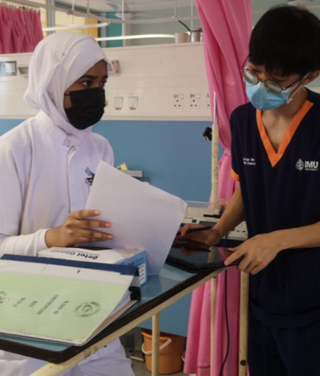
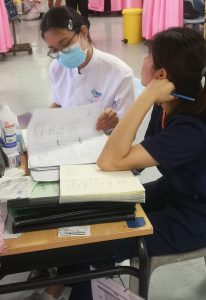
Organised by A/Prof Dr Mohammad Arshad Ikram in partnership with the Nursing Division, the session involved 21 nursing students and 40 medical students. It was strategically scheduled to coincide with both cohorts’ clinical postings in Orthopaedics and the Musculoskeletal System, ensuring seamless integration into their academic commitments. The session was initially designed as a one-to-one pairing, but due to overwhelming interest from medical students, the model was adapted to two medical students working alongside one nursing student. Importantly, the patient was placed at the centre of this learning activity, reminding all participants that teamwork in healthcare ultimately revolves around the person receiving care.
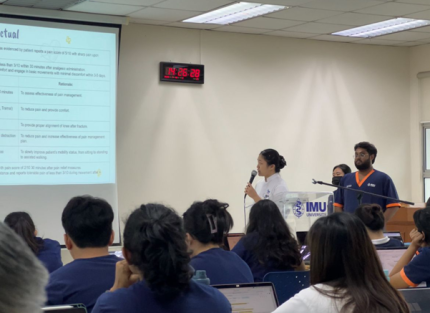
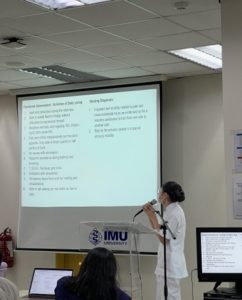
The programme began with a briefing session by A/Prof Dr Mohammad Arshad Ikram, followed by patient interviews and interdisciplinary case discussions between the medical and nursing students. The learning experience culminated in student-led presentations on their findings, which were delivered on 30 July 2025. Leadership and coordination were provided by medical students Sarah Chong Xin Yee (ME221) and Hansel Hakiem Bin Hafizi (ME221), who facilitated group discussions, managed logistics, served as liaisons between medicine and nursing, and took responsibility for collecting and tabulating student feedback.
Feedback from Students
Feedback from both nursing and medical students has been overwhelmingly positive. Many expressed their appreciation for this meaningful opportunity to engage in shared clinical learning and strongly recommended that IPL be made a regular feature of their curriculum. While the overall response was encouraging, the reflections of nursing students from NU 123 provide a deeper look into how this session influenced their learning, confidence, and appreciation of interprofessional teamwork.
TAN JING SHUANG
This was my first time participating in an interprofessional learning session and working with medical students. During the session, we clearly understood our roles and delegated tasks effectively, which made the process more efficient. Thus, I learned the importance of effective communication, mutual respect, and teamwork among healthcare professionals in enhancing patient care. I also found it valuable to listen to opinions from other professions, which helped create a more comprehensive approach to problem-solving.
Besides, I realise that every healthcare professional contributes differently but significantly to patient care. It has broadened my understanding of collaborative practice and will influence how I approach teamwork and communication in my future clinical experiences.
DENISE QUEK LE YUN
Participating in the IPL session was a very meaningful experience for me as a nursing student. At first, I felt slightly nervous and intimidated because I was unsure how well I could contribute compared to the medical students, especially during the bedside interview. I worried that I might not have enough knowledge to match their level. However, as the session progressed, I began to feel more confident. I realised that both professions brought unique strengths and perspectives that complemented each other. I felt proud when I was able to contribute ideas about holistic care and nursing interventions and I also felt grateful for the opportunity to learn directly from the medical students, who shared valuable insights about the condition and medical management options.
Overall, the experience was very positive. The collaboration made the bedside interview more comprehensive and meaningful. The medical students focused on diagnosis and treatment, while I emphasised the patient’s daily needs, comfort and psychosocial concerns. This balance gave the patient a sense that we were addressing them as a whole person, not just their medical condition. I also felt that my communication skills improved, as I needed to explain my thoughts clearly, listen actively and respect different opinions. A challenge I encountered was my hesitation to speak up at times, which made my contribution less visible. However, I appreciated that the medical students were respectful and encouraged me to share my views, which created a supportive learning environment.
From this session, I learned that confidence and clear communication are crucial in interprofessional teamwork. Nurses should not underestimate their contributions, because patient-centred care is equally important as medical management. If given another opportunity, I would participate more actively and speak up earlier, so my perspective is fully included. I would also prepare more thoroughly, such as reviewing common musculoskeletal conditions in advance, so I could contribute at a deeper level.
SAMANTHA LOW YE QING
My biggest takeaway from this IPL session was recognising the clear differences in how nurses and doctors approach patients, and how these roles complement each other. Working with the medical students taught me the value of collaboration in providing more holistic care. This was especially evident during our patient interview, where I contributed to the questioning while also learning from the medical students’ approach to physical examinations and diagnostic reasoning. I realised that combining our strengths created a more thorough assessment and a better understanding of the patient’s needs. This experience showed me that effective teamwork can significantly improve patient outcomes and has inspired me to approach future interprofessional collaborations with greater confidence and openness.
NABILA JASHIM
The IPL session was an insightful experience that signified the need for collaboration between student nurses and medical students. Working together to interview and examine a patient helped me to understand how various professionals view patient care. I learned that a nursing care plan takes on a holistic approach to nursing care, whereas a medical student views a case more toward a diagnosis and medical orders. This collaboration demonstrated the importance of communication as well as teamwork in achieving holistic patient care outcomes.
The highlight of the session for me was when we presented our case to each other. I realized how nursing and medical views can merge to form a unified plan of care. This has motivated me to contribute to patient care with more confidence going forward and also respect other healthcare disciplines in practice that I will be a part of in the future
TAI KAI XUAN
Through the IPL session, I realised the essential collaboration between healthcare professionals, particularly doctors and nurses, where diverse perspectives contribute to comprehensive patient care. We recognised our respective roles and worked together with mutual respect, trust and shared goals, ultimately facilitating the recuperation journey.
This experience has advanced my communication skills with healthcare personnel. I learned to gather and share information in a more structured and respectful manner, while also appreciating the importance of merging perspectives from different professions. The session emphasized how collaborative discussions encourage logical reasoning, strengthen decision-making, and ensure that clinical choices are supported by sound scientific rationales.
The most impactful moment was when both professions worked together on a case discussion. I realised that each profession brought different strengths as medical students focused on diagnostic reasoning, nursing students contributed holistic perspectives on patient care. Simultaneously, I recognised the limitations of each profession, which highlighted why teamwork is essential. Therefore, effective healthcare is not a one-man show but requires a blend of scientific knowledge and technical skills, hence establishing an optimised result.
TING HUI LIN
During the IPL session with the medical students, I gained valuable insights into how collaboration enhances patient care. I appreciated how both professions understood our roles clearly and complemented one another throughout the process. While the medical students focused more on diagnosis and treatment, I contributed by looking at the patient as a whole, including their comfort, daily needs, and overall well-being. This balance gave me a deeper appreciation of how different healthcare perspectives come together to create a more comprehensive care. I also learned a lot from observing the medical students’ approach and reasoning, which helped broaden my own understanding. Overall, this experience reinforced the importance of teamwork, communication, and respecting each profession’s contribution in achieving the best outcomes for patients.
CHONG KAI CHENG
The IPL session was such a valuable experience for me because it gave me the chance to work with medical students in real clinical situations. I realised that each of us had our own strengths which the medical students were more focused on diagnosis and treatment, while nursing students paid more attention to the patient’s overall needs. When we put both perspectives together, the care plan became much more complete. It also reminded me that teamwork is not just about dividing tasks but also learning from each other. This experience has encouraged me to be more proactive in future clinical placements and to always keep communication open with other healthcare professionals.
Moving Forward
Building on the success of this session, the Nursing Division looks forward to collaborating with other schools in organising more interprofessional learning opportunities in the future, with the hope of integrating a stronger research component. Such initiatives not only enhance collaborative practice but also contribute to advancing evidence-based education at IMU.
To experience the highlights of this IPL session, watch the video now on the IMU Nursing Instagram page. We encourage prospective students to explore Nursing at IMU and be part of a community dedicated to collaboration, compassion, and patient-centred care.
Appreciation and Acknowledgement
The Nursing Division extends its deepest appreciation to all faculty members who facilitated the session – Dr Lim Swee Geok, Ms Chow Suh Hing, and Ms Yee Bit Lian, for their invaluable guidance. A special note of thanks goes to A/Prof Dr Mohammad Arshad Ikram for organising and championing this initiative, as well as to medical students Sarah Chong Xin Yee and Hansel Hakiem Bin Hafizi for their outstanding leadership in group facilitation, logistics, and feedback collection.
We would also like to sincerely thank the 40 medical students and 21 nursing students who wholeheartedly participated and collaborated in this event. Their enthusiasm, commitment, and openness to learn from one another were key to making this IPL session a meaningful success.
Article Contributors
This article and accompanying video were a collaborative effort by students and faculty to showcase the spirit of interprofessional learning at IMU, where teamwork and patient-centred care remain at the core of education.
CREDITS
Reviewed by
A/Prof Dr Mohammad Arshad Ikram
Dr Lim Swee Geok
Ms Chow Suh Hing
Ms Yee Bit Lian
Written by Nursing Students (NU123):
Chong Kai Cheng
Denise Quek Le Yun
Nabila Jashim
Samantha Low Ye Qing
Tan Jing Shuang
Tai Kai Xuan
Ting Hui Lin
Faculty Contributor
Lee Mei Ying
Video Editing
Tai Kai Xuan
This was my first IPL with the dietetics students in IMU and it was a very eye opening experience. During the bedside session, I observed how the dietitian students examined my patient and came up with a management plan for them. They pointed out things which I did not pay attention to during my time in the ward such as paying attention to their bony prominences and facial structures to determine their nutritional status. This experience made me realise the importance of multidisciplinary care for all patients in the wards