


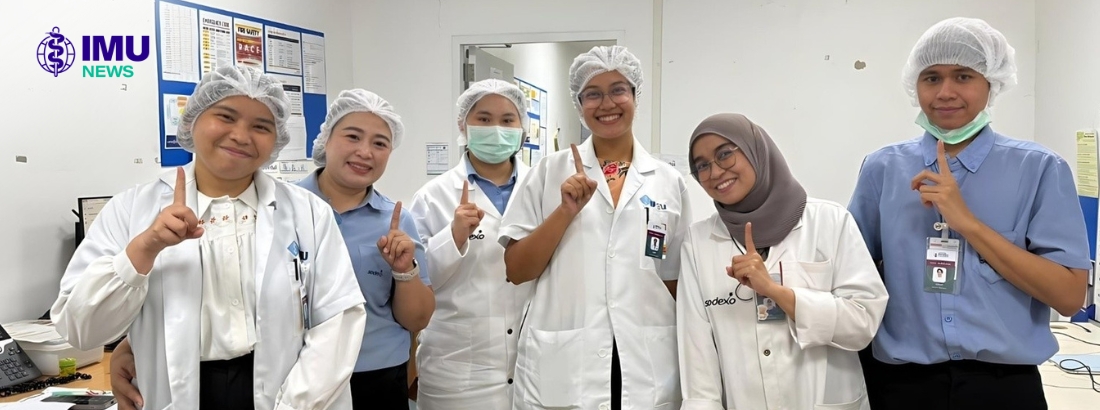
In May 2025, Jyosheeka Selvaraju and Claire Faye Jong, two final-year Dietetics with Nutrition students from IMU University, completed a one-month dietetics internship placement with Sodexo Services at Bumrungrad International Hospital in Bangkok, Thailand. This international placement offered us a rich opportunity to gain valuable hands-on experience in hospital food service dietetics and deepened our understanding of the systems and skills required in large-scale nutrition care.
Bumrungrad International Hospital, located in Bangkok, Thailand, is the largest private hospital in Southeast Asia, offering over 580 inpatient beds and providing world-class healthcare to both local and international patients. The hospital’s food service operations are managed by Sodexo Services, which delivers high-quality, patient-centred meal services with an emphasis on safety, variety, and personalisation.
Meal Service Operations
The food service team under Sodexo consists of a group of professionals dedicated to ensuring patients receive meals that meet their medical, cultural, and personal needs. The team includes 21 kitchen staff, strategically stationed across five specialised kitchens: the cold kitchen, Thai kitchen, Japanese kitchen, Western kitchen, and the Halal kitchen. In addition, 18 service attendants are responsible for the timely delivery of assembled meal trays to the wards and for collecting them after mealtimes. Dietetic services are supported by a team of 18 dietitians and nutritionists, who oversee the planning, implementation, and quality assurance of each patient’s meal plan and the tray line assembly process. Accompanying this team are 6 customer service staff, who take patient meal orders directly via phone or in-person visits to patient rooms, ensuring real-time, personalised communication. Finally, 8 stewards are assigned to maintain strict hygiene and cleanliness standards throughout the kitchen facilities.
Sodexo offers a comprehensive 7-day menu cycle catering to a wide spectrum of dietary needs. These include regular meals for patients with no restrictions, as well as therapeutic diets such as low fibre, low fat, low sodium, diabetic, and neutropenic diets. Texture-modified options like soft and liquid diets are also available, along with meals that adhere to religious or ethical dietary practices such as vegetarian, vegan, and halal.
From the get-go, we were impressed by the structured and efficient food service system, from diet order-taking to kitchen preparation and tray line assembly. Observing the workflow helped us appreciate how standard operating procedures (SOPs), multiple checkpoints, and clear inter-departmental communication are essential to delivering safe, accurate meals to hundreds of patients each day.
Once meal orders are taken and verified by the customer service staff, they are entered into a digital system that automatically generates a personalised menu card. This card contains key information such as the patient’s name, room number, current diet (e.g., regular or soft), allergens, dietary restrictions as noted by doctors or nurses, and the patient’s chosen meal. Each card is printed on colour-coded paper to indicate specific dietary requirements, for instance, white for regular, yellow for allergens, and orange for neutropenic diets. If applicable, additional stickers such as “low fat diet,” “diabetic diet,” or “low sodium diet” are stuck onto the menu card for easy identification.
Meal trays are typically assembled about an hour before mealtime. During tray line assembly, 1–2 dietitians are assigned to four key lines: Thai food, Japanese and Western food, food with allergen restrictions, and halal food. Each dietitian carefully checks that every tray matches the patient’s dietary needs and restrictions. Once verified, the tray’s menu card is stamped to confirm it has been checked. The tray is then placed into a temperature-controlled “Happy Cart” designed to maintain appropriate hot or cold conditions by the service attendants, who deliver the meals to the wards.
We were actively involved in conducting thorough final checks of lunch and dinner meal trays across a variety of cuisines, highlighting the need for attention to detail with therapeutic diets, allergies, and religious requirements. We saw how dietitians play a vital role in ensuring each patient receives the correct meal, both in content and presentation, and observed the careful personalisation of special diets such as low iodine, low potassium, and various texture-modified options, demonstrating that patient-centred care remains a core priority even in large-scale operations.
This personalisation is achieved through the substitution of foods and ingredients to align with various dietary restrictions. For example, patients on a low iodine diet may have their usual afternoon pastry snack replaced with fresh fruits that are low in iodine, while those requiring low potassium diets are served fruits with lower potassium content in place of higher potassium alternatives. Additionally, texture-modified diets are provided to accommodate patients with swallowing difficulties or other specific needs, ranging from soft diets to fully liquid options.
Valuable Clinical Nutrition Experience
Beyond meal service operations, our internship also provided us with valuable clinical nutrition experience. We gained insights into a wide range of oral nutritional supplements (ONS) products, both local and international, learning to evaluate them based on nutritional function and packaging. We also developed hands-on skills in preparing enteral nutrition (EN) feeds, applying calculations to combine multiple ONS products into feeding bags tailored to individual patient requirements.
This was a particularly special experience as it differed significantly from our placement in Malaysia. Typically, from our time at Tuanku Ja’afar Hospital, nurses are responsible for preparing EN feeds at the bedside around six times a day, often with minimal involvement from dietitians in the actual preparation process. However, during our placement in Thailand, we observed that EN feeds were carefully prepared a day in advance in a sterilised area called the tube-feeding room, portioned into three to four feeding bags per patient based on their personalised regimen, and stored in cold storage to maintain safety and quality. When it was time for feeding, the bags were packed in individual containers and transported to the wards for nurses to administer.
Importance of Communication and Collaboration
Throughout the placement, we saw how communication and collaboration are crucial in food service dietetics. Whether it was working with chefs, kitchen staff, or fellow dietitians, we learned that successful patient nutrition care depends on coordination and shared responsibility. Dietitians must clearly communicate patient-specific dietary modifications such as allergen restrictions, texture changes, or various therapeutic diets to the kitchen team to ensure meals are prepared safely and accurately. This often involves checking meal cards, verifying ingredient substitutions, and even following up directly with chefs to prevent errors. We also observed regular discussions between dietitians and kitchen staff during meal prep or service times, ensuring that any last-minute changes such as a patient being transferred, discharged, or requiring a change in their diets were addressed promptly. Teamwork among dietitians was also evident, as they collaborated to cross-check nutrition care plans and ensure that each tray is assembled accordingly, especially allergen restricted trays that need to be cross-checked by two different dietitians.
A Truly Enriching Experience
This internship has been a truly enriching experience for both of us. It not only strengthened our technical and clinical knowledge but also taught us to adapt in a multicultural environment, navigate real-world challenges such as overcoming language barriers and resolving incorrect meal orders, and uphold professional standards in a high-volume hospital setting.
We are sincerely grateful to IMU University and Sodexo Services for this opportunity. The lessons we’ve learned during our internship in Bangkok will guide us as we take the next steps in our dietetics journey.
Thoughts Shared