


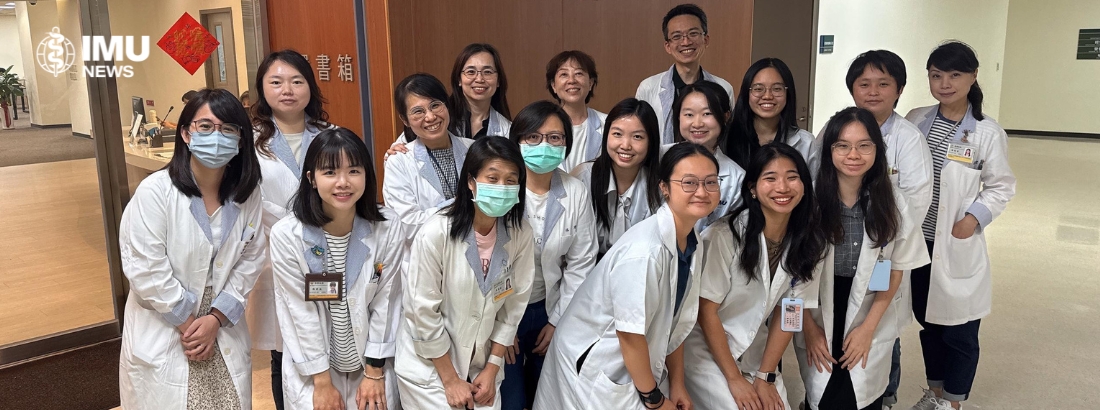
In May 2025, a group of seven final-year Dietetics with Nutrition students from the DN121 cohort had the remarkable opportunity to complete a one-month placement at Chang Gung Memorial Hospital in Linkou, Taiwan. This valuable experience offered an opportunity for us to observe and understand how dietetics and healthcare practices are implemented in a different country, broadening our perspectives on international healthcare systems and nutrition care approaches.
Seven Final-year Dietetics with Nutrition Students in this Placement
- Jean Ann Sau Jing En
- Jim Mee Sha
- Cheang Yee Shan
- Esther Ooi Wen Hui
- Goh Sher Lin
- Chia Yuanyin
- Tan Chien Chien
Learning from Experienced Dietitians (Clinical Rotations)
During our placement at Linkou Chang Gung Memorial Hospital, we had the opportunity to shadow experienced dietitians across a wide range of specialties, including critical care, nephrology, surgical, pediatrics, and diabetes care. This multidisciplinary exposure provided us with valuable insights into the management of diverse clinical cases and allowed us to observe different approaches to dietetic practice within a different healthcare system.
One of the key differences we noted was in the documentation process. In Taiwan, dietitians utilise an efficient online system and favour a highly concise, straight-to-the-point documentation style. This streamlined approach is especially effective for managing a large patient load, enabling dietitians to chart quickly and clearly without compromising care. In contrast, while Malaysia is gradually transitioning toward digital systems, many hospitals still rely on traditional paper-based documentation and tend to be more detailed in nature.
We also participated in insightful case discussions with the dietitians, which not only reinforced our existing knowledge and clinical skills but also broadened our perspective on dietetic care across various healthcare settings. This was especially true as we were exposed to complex cases that are less commonly encountered during our clinical placement in Malaysia, such as liver transplant patients, severe burn cases, and individuals undergoing skin graft procedures.
Additionally, we observed that total parenteral nutrition (TPN) was commonly utilised in these settings, with in-house pharmacists actively involved in adjusting both macronutrient and micronutrient content, highlighting the high level of collaboration and specialisation within the team. Observing the effective communication and coordination among members of the multidisciplinary healthcare team further reinforced the importance of teamwork in delivering comprehensive, patient-centered care.
Food Service Operations
In addition to our clinical rotations, we also had the opportunity to observe the hospital’s food service operations. At Linkou Chang Gung Memorial Hospital, both external catering and in-house food production are utilised to meet the needs of a large patient population. Standard meals are prepared by an external caterer to efficiently serve the high volume of patients. Meanwhile, therapeutic and special diets, such as the diabetic diet, low-residue diet, and modified-texture meals that require more meticulous planning, are prepared in-house.
We also observed a food service dietitian stationed at the tray line to ensure that the therapeutic meals were accurate, appropriately portioned, and tailored to each patient’s dietary requirements. The dietitian also plays a crucial role in ensuring that food safety protocols are strictly adhered to throughout the meal preparation and distribution process. This includes checking food for physical contaminants, ensuring that food handlers wear proper attire, and monitoring the cleanliness and organisation of the kitchen space to maintain hygiene standards and prevent cross-contamination.
Community Outreach
Beyond the clinical and food service scene, we also noticed that there is more community outreach efforts and support groups initiated by hospitals, which frequently integrated dietitians’ contributions. This provided greater visibility and patient interaction beyond traditional clinical settings, broadening our perspective on how the role of dietitians can extend beyond hospital walls to support long-term care and patient empowerment.
One of the most memorable community events was observing a support group event for patients with chronic kidney disease (CKD) undergoing peritoneal dialysis (PD). The event served as a safe and supportive space for patients with shared experiences to connect, share concerns, and learn from both medical professionals and one another. It featured engaging presentations by the medical and nutrition teams, both of which were well-received and sparked active participation from attendees. It was inspiring to witness such open dialogue and strong patient engagement, which was a testament to the holistic approach and emphasis on multidisciplinary teamwork practised here, and painted a picture of what dietitians can do.
Overall, while the job scope of dietitians remains the same, we noticed a significant dedication towards high quality patient care here in Taiwan – from the well-defined specialties, concise digital documentation, strong emphasis on multidisciplinary teamwork, meticulous meal evaluation, to elaborated community events.
This experience not only deepened our clinical knowledge, but it also expanded our understanding of how dietetics can evolve to become more integrated, impactful, and patient-focused.
Living Arrangements and Daily Life
Accommodation
Our placement site provided lodging at within walking distance of the hospital and many other shops (convenience stores, restaurants, streets foods, grocers). This allowed us to save on transportation costs and made our daily routine more convenient. The accommodation was included in the training fee of NT$2000 (~RM285), which was very reasonable for the location and comfort provided.
Transport
Getting around Taipei was easy and accessible thanks to the extensive public transport network, including trains, buses, and rental bikes. We also made use of the T-Pass, a 30-day travel card offering unlimited rides within Taipei from just NT$1200 (~RM170). It made commuting smooth and gave us the freedom to explore the city after hours.
Food
There were lots of affordable, wholesome options from convenience stores to street food. Whether it was a quick breakfast or dinner after a long day, good food was always within reach.
A Memorable and Enriching Internship
Overall, this internship was both memorable and deeply enriching. The exposure has broadened our perspectives, enhanced our clinical and communication skills, and given us new ideas to support the growth of dietetics back home in Malaysia.
We are truly grateful to IMU University for supporting our journey, and to the dedicated dietitians and staff at Linkou Chang Gung Memorial Hospital for their guidance, generosity, and hospitality. This experience was more than just a placement, but rather a transformative chapter in our learning journey – one we’ll carry forward proudly.
Related article: Insights from Taiwan: Inspiring a New Generation of Dietitians
Thoughts Shared