


Article Summary
IMU IRDI and Elsevier hosted a training programme on systematic reviews and Embase, equipping researchers with essential skills in evidence synthesis and AI-supported literature search.
Quick Glance
Event:
IMU–Elsevier Training Programme
Date:
23 April 2026
Focus:
Strengthening Systematic Review and Evidence Synthesis Skills
An Engaging Session with Academics, Researchers and Students
The Institute for Research, Development and Innovation (IRDI) of the IMU University successfully hosted the IMU–Elsevier Training Programme on 23 April 2026, bringing together academics, researchers, and students for an engaging session focused on strengthening:
- Systematic review and
- Evidence synthesis skills.
Held at the Senate Room, IMU Bukit Jalil Main Campus, the programme attracted participants from within IMU as well as external attendees, including faculties and postgraduate students from Sunway University. The session began with a networking lunch, fostering collaboration and exchange among participants.
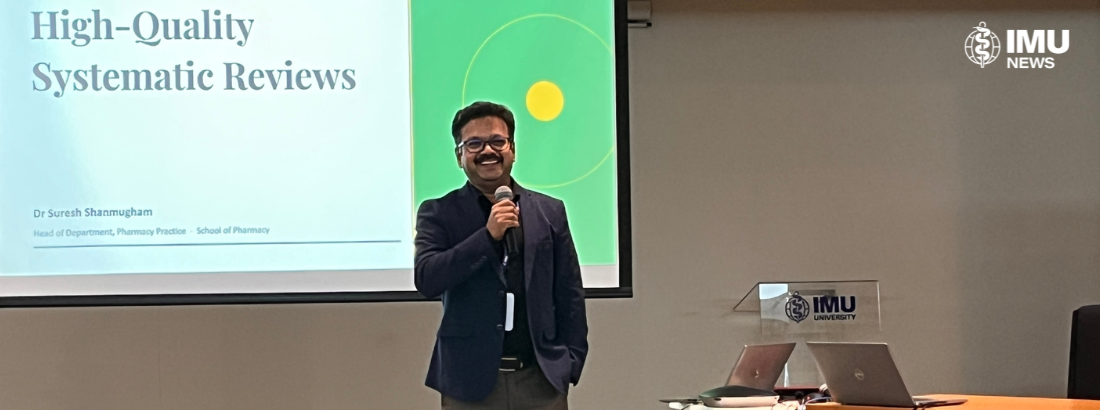
Session on Conducting High-quality Systematic Reviews by Dr Suresh Shanmugam
A key highlight of the programme was a session on conducting high-quality systematic reviews delivered by Dr Suresh Shanmugam, Senior Lecturer and Head of the Department of Pharmacy Practice at IMU.
A systematic review is a structured and rigorous method of analysing and synthesising existing research evidence to answer a specific research question. It plays a critical role in evidence-based practice, helping clinicians and policymakers make informed decisions based on comprehensive data.
By systematically identifying, evaluating, and analysing all relevant studies, it helps minimise bias and ensures that conclusions are based on the totality of available data rather than individual studies.
Introduction to EMBASE through a Hands-on Training Session by Mr Ryan Huang
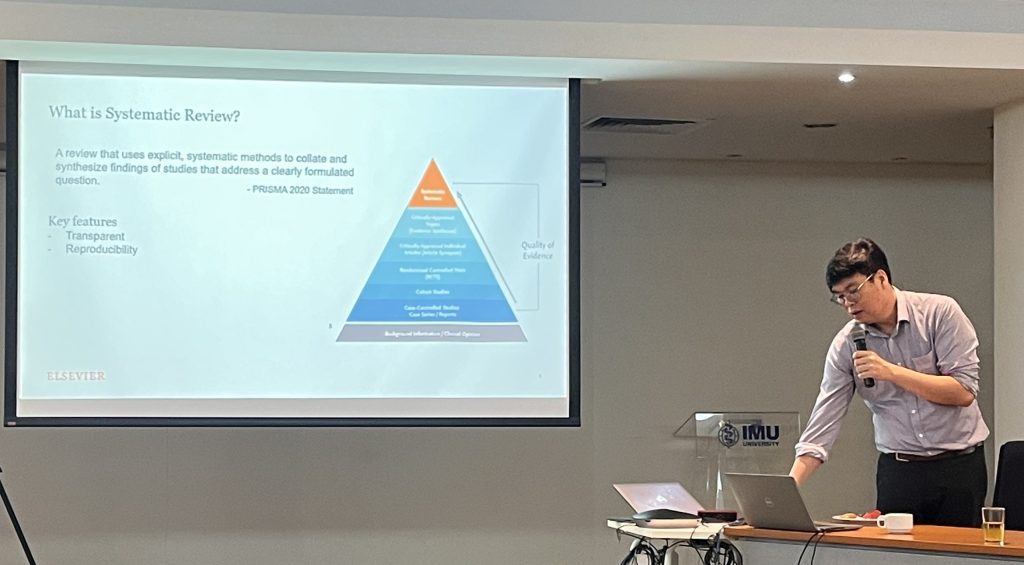
Participants were then introduced to EMBASE through a hands-on training session led by Mr Ryan Huang, Account Manager at Elsevier where he works at the intersection of life science research and AI-driven innovation.
EMBASE is a comprehensive biomedical and pharmacological database produced by Elsevier that enables researchers, clinicians, and students to perform in-depth literature searches, identify relevant studies, and support high-quality research outputs.
Widely used in academia and industry, it is a key tool for conducting systematic reviews and ensuring robust evidence retrieval. It uses a specialised indexing system (Emtree) that helps users find relevant studies more accurately and efficiently.
Skills Gained

Learning systematic reviews and Embase equips researchers with the “gold standard” skills for evidence-based practice. Participants gain the ability to critically appraise study quality and identify knowledge gaps, moving beyond simple literature summaries to produce high-impact research.
Proficiency in Embase specifically ensures a more comprehensive search by providing access to
- Over 3,500 unique journals and
- Extensive conference data not available in other databases.
These combined skills empower participants to:
- Produce highly citable research and
- Make more informed decisions in clinical and policy settings.
Participant Reflections
“The workshop presentation on “Tips for High Quality Systematic Review” strengthened my methodological rigor in conducting meta-analyses, while the hands-on demonstration by the Elsevier staff on Embase database provided valuable insights into its advanced indexing and search functionalities. I would like to thank IMU University, particularly IRDI and Prof Mai, for initiating this collaboration and the IMU–Elsevier Embase Challenge Programme, which will support improved publication output through the application of these enhanced skills in producing more rigorous and comprehensive systematic reviews.”
“The seminar on systematic review and EMBASE new function is fun and interesting to me. Although I am currently halfway through writing a systematic review, it is refreshing to learn again the key technique presented by experienced lecturer, effectively reinforcing my understanding and addressing my shortcoming. The walkthrough of new function is intriguing, showing how much AI can help in reducing manual workload and prompting idea, but of course, as highlighted by Dr Ryan, it is not meant to replace but to support.”
“The EMBASE training broadened my perspective on review writing. I was truly impressed by how systematic search strategies can reveal the collective brilliance of researchers’ work in an accessible way.”
From Training to Application: Embase Challenge Programme
The programme concluded with the launch of the IMU–Elsevier Embase Challenge Programme, an initiative aimed at encouraging participants to apply their newly acquired skills in literature searching and evidence synthesis.
This training programme reflects IMU’s ongoing commitment to advancing research excellence and equipping its community with the tools and knowledge needed to thrive in an increasingly data-driven and evidence-based healthcare landscape.
Thoughts Shared