


At a Glance
- IMU University psychology graduate Dinie Joshry Shaqeel shares how choosing psychology led to unexpected career opportunities.
- Small class sizes and supportive lecturers encouraged personal growth and openness to new experiences.
- Through competitions, volunteering, research and leadership, Dinie developed skills beyond the classroom.
- An industrial attachment at Khazanah Research Institute introduced him to policy research, AI harms and child online safety.
- Today, he hopes to bridge psychology with public policy and inspire more psychology graduates to contribute to society.
Choosing Psychology
My name is Dinie Joshry Shaqeel, a graduate of the PS1/23 cohort of IMU University’s undergraduate psychology programme. I am by no means the perfect student and am in no position to give advice, but my educators believe that someone out there might stand to benefit from hearing about my experiences.
After a tumultuous period of figuring out what I wanted to pursue as my undergraduate degree, I ultimately realised that I wanted to pursue psychology. I always had an ingrained curiosity about how humans operate and why we do the things we do. It was not an easy decision. I always had the urge to pick something more “normal”, like medicine or dentistry – something that would make the relatives say, “Wow”. However, I am eternally grateful to my parents, who understood my decision and supported me throughout my journey.
Finding a Sense of Belonging at IMU University
This decision marked the beginning of my exploration of “the road less travelled”. Within the first semester of my psychology degree, it dawned on me that I had made the right decision. Predominantly, I have the lecturers to thank.
Psychology cohorts tend to be smaller, and my cohort was especially small. This allowed me to connect more with my lecturers. It felt like a family of sorts, and they made me feel like I belonged. I learnt not only the syllabus, but also respect, communication, accountability, and conscientiousness.
Learning Beyond the Psychology Classroom
One of the most widely used frameworks in personality psychology is the Five-Factor Model by Costa and McCrae. I want to highlight “openness to experience”. Having a conducive learning environment at IMU facilitated my openness, which made me want to try new things.
There was no shortage of opportunities, I:
- Took part in fitness challenges, public speaking competitions and debates,
- Moderated and emceed events,
- Presented research at an international conference
- Volunteered to clean beaches, and
- Taught refugee children.
With each experience, my perspectives expanded. I learned something I previously did not know, and this proved integral to my development not just as a student, but as a human being.
Discovering Policy Research Through Industrial Attachment
As I approached the end of my undergraduate journey, it came time for my industrial attachment. My thesis supervisor, Dr Shamala, suggested that I apply to the Khazanah Research Institute (KRI).
Up until my final year, I did not even know such a career existed. I had next to no knowledge of economics and public policy, yet I was given a golden ticket, and I did not intend to waste it. Allowing myself to once again be open to experience, I learnt as much as I possibly could. I learnt from colleagues with economics and international relations backgrounds and from my supervisor, Dr Jun-E Tan, whose policy research prowess continues to inspire me today.
Applying Psychology to AI Harms and Child Online Safety
Surprisingly, I found myself applying the psychological lens I cultivated at IMU to issues such as AI harms and child online safety. After weeks of research, learning, and writing, I had a feeling not unlike the one I felt in my first semester of psychology. This profession had been completely unbeknown to me, yet now it has become both my passion and my career.
Receiving the Professor Emerita Datuk Dr Asma Ismail Gamechanger Award
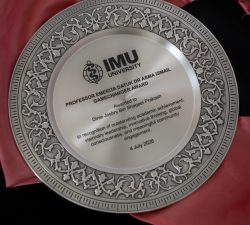
Recently, I was deeply humbled to learn that I would be receiving the Professor Emerita Datuk Dr Asma Ismail Gamechanger Award.
When I reflect on what contributed to this, I realised that being a “gamechanger” never meant reinventing the wheel.
For me, it meant consistently choosing the road less travelled. A continuous loop of staring into the unknown and saying, “I’ll give it my best shot.” This, though, is not the end of my path in psychology.

Why Psychology Matters
Policy research and policymaking would massively benefit from evidence-based psychological expertise, which is exactly why I am working on initiatives to open the door for more psychology students to contribute to important social issues through policy and civil society work.
As Dr Lisa Willner from the American Psychological Association said:
“We need all kinds of people in the legislature. We need our big idea people, we need our bomb throwers, and we need level-headed people who can hold some of the turmoil and be a centre of calm. Psychologists are better trained for that than anyone else I can think of. From my perspective, we are cut out for this, particularly in this moment.”
Choosing the Road Less Travelled
Many times, we find ourselves at crossroads where fear and doubt make it easy to stay within our bubble of safety.
Before you let that illusion of safety make the decision for you, consider the road less travelled.
Be open to experience.
You just might find something you never knew you were looking for.
Sometimes, the view on the road less travelled is more beautiful than you could ever imagine.
Photo credits: Ryan Tan Wei Jian
Thoughts Shared