


At a Glance
- Semester 4 Bachelor of Nursing students at IMU University participated in the “Pack It Right!” wound packing workshop before their clinical postings.
- The workshop combined theoretical knowledge with hands-on practice in wound packing.
- Students learned the indications, principles and techniques for managing cavity wounds safely.
- Live demonstrations, supervised practice and immediate feedback helped strengthen students’ confidence and clinical competence.
- The workshop reflects IMU University’s commitment to preparing practice-ready nursing graduates.
Preparing Nursing Students for Clinical Placements
On 15 June 2026, the Nursing Division of IMU University conducted the “Pack It Right” wound care workshop for the Bachelor of Nursing (BNU) students in Semester 4, Cohort NU124. This session led and organised by Ms Lee Mei Ying, focused on equipping us with fundamental knowledge and hands-on skills needed for safe and effective wound packing in the clinical area. As a member of the organising committee, being part of the process of bringing the workshop to life enhanced my experience – and as a student sitting through it, I found it just as valuable as my peers.
Learning the Principles of Wound Packing
Held at the Seremban Clinical Campus, just before our clinical postings commenced, the workshop was designed to address on cavity wounds with sinus tract, tunnel, or undermining with known end-points where the wound packing technique is indicated to facilitate removal of exudate and debris, as well as encourage growth of granulation tissue to allow secondary intention healing.
Prior to the session, we were provided with digital handouts to facilitate self-directed learning beforehand. These covered the purpose, principles, indications, and contraindications of wound packing, along with a procedural checklist that helped us come into the session with foundational understanding.
Hands-On Wound Packing and Wound Irrigation Training
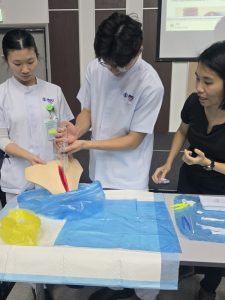
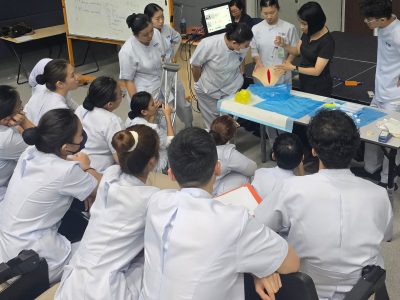
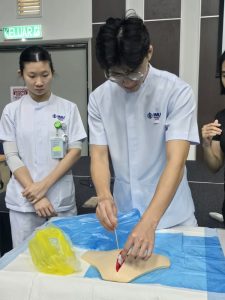
The session commenced with a live procedural demonstration running simultaneously with a supervised hands-on practice using a wound dummy, where we were also exposed to the technique for wound irrigation. Ms Mei Ying also demonstrated wound packing using various materials, such as gauze and ribbon gauze, offering a glimpse into real clinical practice beyond theoretical knowledge.
Despite time constraints, we were encouraged to practice the skill independently by fashioning our own wound cavity using a dish sponge, along with a provided set of dressing materials. Throughout the session, we were actively prompted to voice out any uncertainties, which were swiftly clarified by the following real-time feedback.
Bridging Theory and Clinical Nursing Practice
As a student myself, the step-by-step demonstration was invaluable in bridging the gap between theory and practice — something I had been eager to work on ahead of our clinical postings. Though the workshop session could not fully encompass a true clinical setting, the real time insight and commentary with each step left me feeling more prepared, having a clearer reference point for future wound packing cases.
Nursing Students Reflect on Their Learning Experience
A few of my classmates also shared a similar sentiment,
The session has improved my understanding of the rationale behind wound packing in promoting healing and preventing complications, while strengthening my confidence and critical thinking in wound management. – Soraiya, NU124
Another cohort-mate shared,
The demonstration also provided clear guidance on how to perform the procedure and what is expected when encountering such wounds in clinical practice.
Developing Competent and Practice-Ready Nurses
In closing, “Pack It Right!” was more than just a skills workshop — it was a reminder of why we chose this profession. Wound care, as technical as it may seem, is ultimately an act of compassion and precision, and workshops like this bring both of those values to life. At the same time, it stands as a testament to IMU University’s commitment to producing clinically competent and practice-ready nurses.
Acknowledgements
Gratitude is owed to Ms Lee Mei Ying, for her dedication and expert facilitation in designing and leading this session with such clarity and patience; Ms Goh Lay Khim and Ms Deepa A/P Kaliappen for supporting the workshop by preparing procedural materials.
I would also like to extend my sincere appreciation to my fellow organising committee members – Jaclyn Lu Zi Wei and Pung Hui Jing for the experience of working together and learning how to organise a student-led workshop.
Special thanks to Lim Wen Hao for contributing his photography expertise to capture the photos for the workshop.
Written by Jamey Seow Tze Chee (NU 1/24)
Reviewed by A/Prof Dr Lim Swee Geok and Ms Lee Mei Ying
Thoughts Shared