


An IMU medical student shares her experience at GLOBEHEAL 2026, highlighting sustainability in public health, undergraduate research, global collaboration, and leadership recognition.
The 9th Global Public Health Conference (GLOBEHEAL 2026), organised by The International Institute of Knowledge Management (TIIKM), was held in Bali, Indonesia from 12–13 February 2026. The conference brought together academics, researchers, policymakers, and public health professionals from around the world to exchange knowledge, explore innovative solutions, and address contemporary global health challenges. It provided an invaluable platform for interdisciplinary collaboration, scholarly dialogue, and the advancement of evidence-based and sustainable public health initiatives.
The scientific programme covered key global priorities, including
- health policy governance and primary healthcare,
- non-communicable diseases (NCDs) and lifestyle interventions,
- innovations in public health,
- social determinants of health and health equity,
- mental health and psychosocial wellbeing, and
- maternal, child, and adolescent health.
These discussions highlighted the growing need for integrated, prevention-focused, and equitable approaches to improving health outcomes worldwide.
My participation in this prestigious conference was marked by two major achievements: being recognised as the Country Coordinator for Malaysia and presenting independently initiated undergraduate research on sustainability education.
Recognition for Leadership: Country Coordinator for Malaysia
During the opening ceremony, I was honoured with an appreciation award in recognition of my role as the Country Coordinator for Malaysia.
This recognition reflected contributions toward promoting Malaysian participation in an international academic platform and facilitating collaboration between local participants and the global public health community.
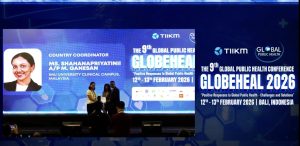
Receiving this acknowledgement among distinguished scholars and professionals underscored the value of student leadership in global academic engagement. It demonstrated that undergraduate students can actively contribute to international scholarly communities and play meaningful roles in advancing public health discourse.
Advancing Sustainability through Undergraduate Research
A central highlight of the conference was the presentation of my research titled “Perceived Knowledge, Perception and Readiness of University Students regarding Sustainability Education & Practice.” Initiated in 2024 as a self-driven project, the study reflects my strong commitment to advancing sustainability within higher education and public health education.
The research was presented under the session “Innovations in Public Health,” recognising sustainability education as an essential component of forward-looking public health strategies. The study provides baseline evidence prior to integrating sustainability initiatives into the university campus, examining students’ awareness, perceptions, and readiness to engage in sustainable practices.
The research received ethical approval from the IMU Joint Committee on Research and Ethics, ensuring compliance with rigorous academic and ethical standards. It has also been published in the Journal of Sustainability Research, contributing to the growing literature on sustainability education and institutional transformation.
This work was conducted under the guidance of Prof Khoo Suan Phaik, Dean, Community Engagement, and A/Prof Pathiyil Ravi Shankar from the IMU Centre for Education (ICE), whose mentorship provided invaluable guidance throughout the research process.
The study was further strengthened through collaboration with my colleagues:
- Muhammed Ellhaam bin Juahir (ME121),
- Seow Pui Ee, Yeo Ke Shuen,
- Sarvesen a/l Chithiramanaalan, and
- Kerthana Devi a/p Premanenth (ME222)
Their contributions were instrumental to the research’s successful completion.
I presented my research alongside master’s and PhD students as well as professors, making me one of the very few undergraduates participating in the session.
As part of the presentation, I engaged in a forum-style discussion where presenters exchanged perspectives and responded to questions about their research. Initially challenging, the experience allowed me to articulate ideas clearly, engage in meaningful scholarly dialogue, and gain confidence as a young researcher.
Many delegates expressed surprise and encouragement upon learning that the research was led at undergraduate level, highlighting the increasing importance of early student involvement in global research initiatives.
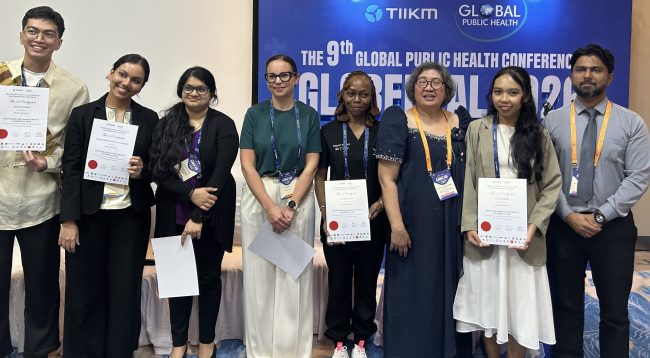
The experience was transformative and strengthened both my academic confidence and professional communication skills.
Global Engagement and Scholarly Exchange
The conference provided opportunities to interact with delegates from Sri Lanka, Zambia, Canada, Ireland, Indonesia, and India, enabling discussions on sustainability education across diverse cultural and institutional contexts.
These exchanges underscored the universal relevance of sustainability within public health and demonstrated the value of collaborative global dialogue in addressing shared environmental and societal challenges.
A particularly memorable experience was engaging with Mr Isanka P Gamage, Managing Director of The International Institute of Knowledge Management (TIIKM).
Our discussion centred on sustainability advocacy, student-led research, and the role of young scholars in shaping future public health initiatives. He expressed appreciation for the depth of our dialogue and remarked that I was “starting off strong as an undergraduate,” an encouragement that reinforced the value of pursuing research and leadership opportunities early in one’s academic journey.
Key Learning Experiences and Emerging Public Health Insights
Beyond presenting research, the conference provided exposure to cutting-edge developments in global public health. Discussions highlighted the increasing recognition of oral health as an integral component of systemic health, particularly its association with oesophageal and gastric cancers, emphasising the importance of preventive, interdisciplinary healthcare approaches.
Innovative vector control strategies were also presented, including the use of Wolbachia-infected Aedes aegypti mosquitoes, a natural, safe, and non-genetically modified method to reduce dengue transmission. These insights illustrated how scientific innovation can support sustainable, community-based disease prevention.
Additionally, sessions on somatic education therapy introduced holistic approaches integrating body awareness, movement, and psychological wellbeing, reflecting the growing adoption of biopsychosocial models in healthcare.
Reflections and Future Aspirations
Participating in GLOBEHEAL 2026 represented more than an academic milestone; it reaffirmed my commitment to sustainability, research, and global public health advocacy.
Being recognised for leadership while presenting ethically approved and published research as an undergraduate demonstrated the meaningful contributions that students and early-career researchers can make on international platforms.
Building on the insights and momentum gained from GLOBEHEAL 2026, my next step is to organise IMU’s first Sustainability Living Lab. This initiative aims to bring together key stakeholders including academic staff, students, and operational teams to collaboratively brainstorm realistic, context-specific strategies that transform baseline research data into measurable and sustainable action.
By creating a structured platform for interdisciplinary dialogue and co-creation, the Living Lab will serve as a bridge between evidence and implementation, ensuring that sustainability efforts at IMU move beyond awareness into meaningful institutional transformation.
I hope this journey encourages fellow students and young researchers to confidently pursue their passions and seek opportunities to contribute to areas they care deeply about.
Meaningful change does not always begin with large-scale initiatives; consistent efforts grounded in curiosity, commitment, and collaboration can collectively create significant impact. By stepping forward and engaging in global conversations, students have the capacity to not only grow achttps://imu.edu.my/academics/undergraduate/medicine/ademically but also contribute toward shaping a more sustainable and equitable future.
Written by Shahanapriyatinii A/P M Ganesan, IMU Medical Student from Cohort ME221

Thoughts Shared