


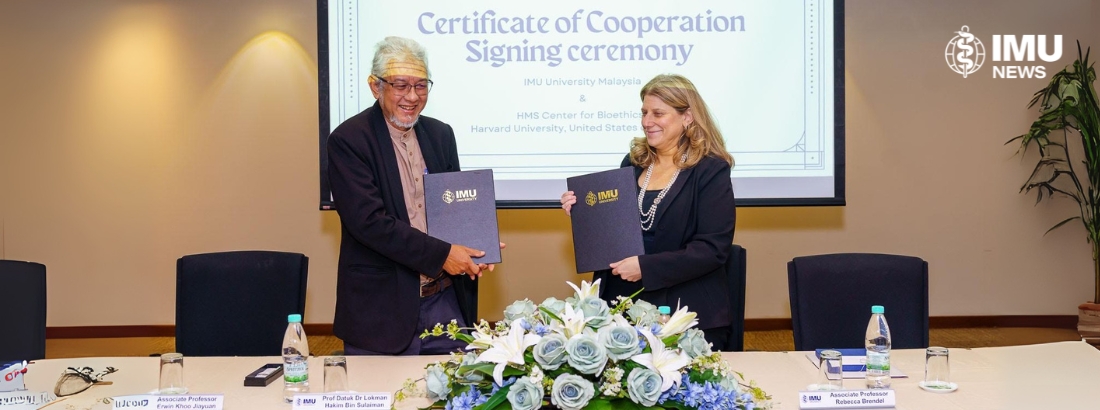
A focal moment in the “Ethics on the Edge: A Public Forum on Healthcare, Profits, and the Public Good” forum, held on Sunday,29 June 2025, was the formal Signing Ceremony of a Certificate of Cooperation between the Harvard Medical School Center for Bioethics and IMU University. This event, which took place in the Senate Room, was the culmination of months of dedicated effort and hard work, initiated by A/Prof Dr Erwin Khoo Jiayuan, Head of Paediatrics Department at IMU University and Affiliate to the Center for Bioethics at Harvard Medical School. The signing highlighted a shared commitment to advancing bioethical standards and marked a pivotal step in this ongoing collaboration.
The Certificate of Cooperation serves as a testament to the mutual appreciation and collaborative spirit between these esteemed institutions. The signatories, representing the pinnacle of their respective organisations, included Associate Professor Dr Rebecca Brendel, Director of the HMS Center for Bioethics; Prof Datuk Dr Lokman Hakim Sulaiman, Deputy Vice Chancellor, Research, representing Academician Prof Emerita Datuk Dr Asma Ismail, Vice-Chancellor & CEO, IMU University; and Dr Erwin Khoo. This formalisation of this partnership sets the stage for future collaborations aimed at addressing the complex ethical challenges facing healthcare in Malaysia and globally.

Public Forum
IMU University, in a collaboration with the Harvard Club of Malaysia, and supported by Angsana Health and the Malaysian Philosophical Society, then hosted the public forum at the Mei Ling Young Auditorium. This event, which convened over 150 multidisciplinary participants—including healthcare professionals, academics, policymakers, industry stakeholders, ethicists, and members of the Harvard and philosophical communities—served as a platform for discussions surrounding Malaysia’s healthcare future and its ethical landscape.
The objective of “Ethics on the Edge” was to ignite public discourse on Malaysia’s escalating medical inflation and the nation’s dual healthcare crisis: an overburdened public sector and an increasingly unaffordable private sector. Malaysia’s medical inflation recently surged to approximately 12.6% (with some reports indicating up to 15% in 2024), nearly double the global average of 5-6%. This sharp rise is attributed to increased service volume and costs, the growing burden of non-communicable diseases, higher demand for advanced health services driven by economic growth, and rising cost drivers such as supply chain instabilities, medical labour shortages, wage pressures, and rapid adoption of new technologies. Compounding these challenges, insurance premiums have also seen significant increases, ranging from 40% to 70%, further impacting affordability.
The forum began with welcoming remarks from Nadiah Wan, Immediate Past President of the Harvard Club of Malaysia. She highlighted the unsustainability of the current healthcare situation and proposed forward-thinking health financing solutions. These included redirecting funding towards primary care and prevention, building robust data infrastructure for transparency, and proactively regulating health insurance with clear mandates and risk-sharing, while also dispelling the misconception of premiums as forced savings.
Dr Erwin Khoo, the Organising Chair and Affiliate of the Center for Bioethics at Harvard Medical School, challenged the audience to envision an ideal healthcare system, one that is just, compassionate, and humane, with dignity as its cornerstone. Dr Khoo posited that seeking profit in healthcare is not inherently unethical, as investment and entrepreneurship are vital for progress. However, he cautioned that it becomes unethical when profit undermines the public good, dictating care based on financial statements rather than principles of justice, compassion, and dignity.
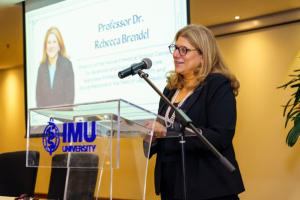
Dr Brendel skillfully framed the day’s keynote by highlighting the inherent complexity of fairness in healthcare. Through the deceptively simple question, “How do we divide an orange justly?”, she illustrated that while the desire for fairness is universal, its practical application, especially in critical sectors like healthcare, is often contested and demands thoughtful deliberation. She explained that a just system for moral equals entails a framework of rights, liberties, rules, and economic structures that respects primitive legitimacy, addresses misfortune, ensures functionality, achieves consensus, and promotes shared values.
Khoo Eu Wen, President of the Harvard Club of Malaysia, then expressed pride in the active participation of both emerging and established healthcare leaders, signaling a shared commitment to shaping a fairer, more resilient health system. In a parallel announcement, the Harvard Club of Malaysia celebrated the admission of several distinguished Malaysian students to Harvard University for the 2025–2026 academic year.
Two Dynamic Debates On The Motion: “This House Would Cap All Healthcare Prices in Malaysia”
A central and engaging feature of the forum was two dynamic debates on the motion: “This House Would Cap All Healthcare Prices in Malaysia”.
An early highlight was a “Shadow Debate” featuring talented IMU medical students Sarah Emily Bahari (MB124 Medical Biotechnology), Ashvin Narayanan (ME124 Medicine), Aisswarya Ng (ME224 Medicine), and Chong Jia Ern (ME124 Medicine), moderated by Dr Khor SK. They cleverly explored the complex balance between protecting patients through price caps and the potential strain such measures could place on the healthcare ecosystem.
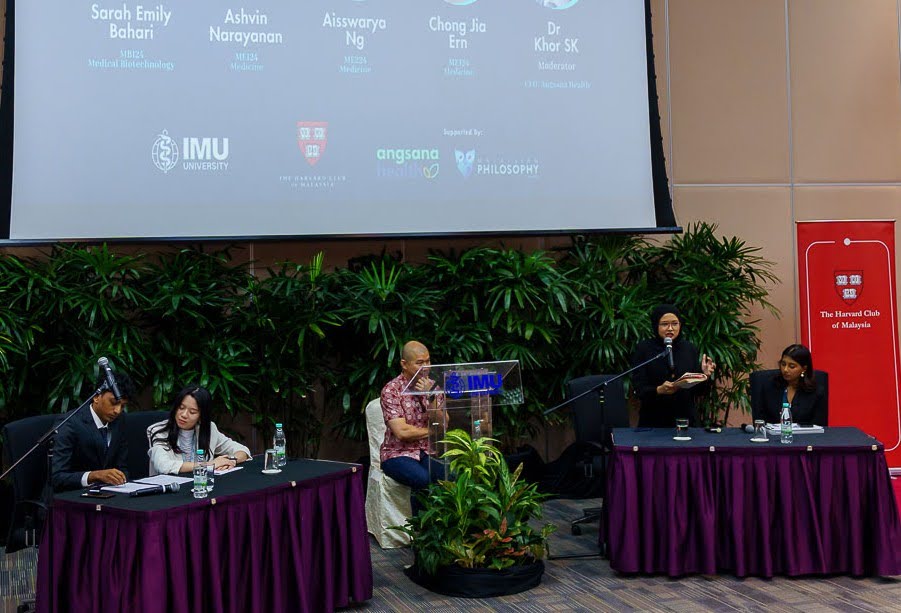
This was followed by the main debate, showcasing an esteemed panel of experts:
Dr Michael Jeyakumar Devaraj
(Chest Physician, Chairman of Parti Sosialis Malaysia)
Dr Michael Jeyakumar Devaraj defined healthcare as a public good, arguing that oligopolistic practices dominate Malaysia’s healthcare industry, limiting competition and driving up prices.
Dr Milton Lum Siew Wah
(Obstetrician-Gynaecologist, former President of the Federation of Private Medical Practitioners Associations of Malaysia)
Dr Milton Lum Siew Wah provided an analysis of current regulations, emphasising that outdated legislation and poor data transparency hinder effective policy responses. He highlighted the complexity of medicine and diagnosis, as well as potential conflicts of interest arising from Government-linked companies’ ownership in the private sector.
Dr Murallitharan Munisamy
(Managing Director of the National Cancer Society Malaysia)
Dr Murallitharan Munisamy opened with a poignant true-story illustrating the unaffordability of life-saving medications in Malaysia. He highlighted the unique nature of the healthcare market and its distortion by oligopolies, proposing a dynamic, regularly adjusted cap on healthcare prices, tailored to evolving economic and industry data.
Dato’ Dr Ahmad Faizal Mohd Perdaus
(Respiratory & Internal Medicine Physician)
Dato’ Dr Ahmad Faizal Mohd Perdaus opposed fixed price caps, cautioning that they could stifle medical innovation. Instead, he advocated for strategies to strengthen the development and use of generic pharmaceuticals and introduced an alternative model aiming to reduce middlemen and streamline healthcare costs.



Thoughts Shared