


Article Summary
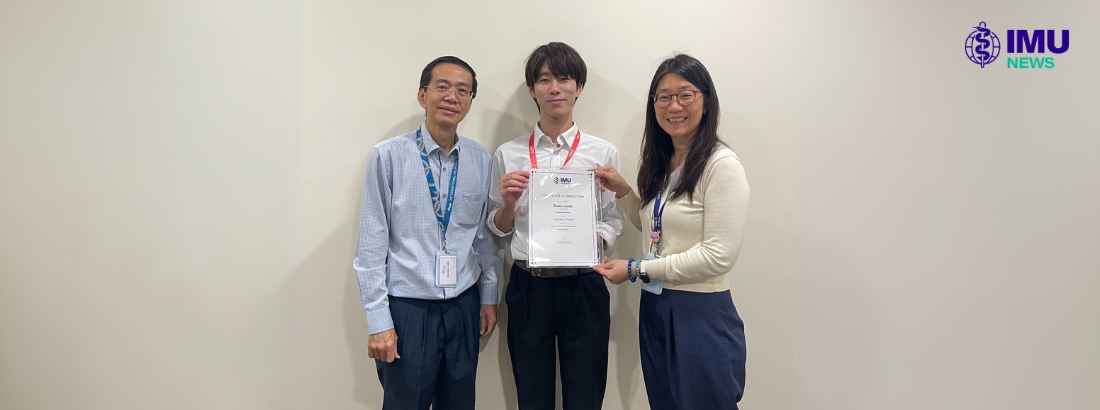
As part of an international research attachment at IMU University, Yutaro Asaki, a fourth-year Pharmaceutical Sciences student from Kyushu University, Japan, spent two months contributing to cancer-related research on CYP2W1, a cytochrome P450 enzyme expressed in certain cancers.
At a Glance
Programme:
International Research Attachment Programme
Participant:
Yutaro Asaki, Fourth-Year Pharmaceutical Sciences Student
Home Institution:
Kyushu University, Japan
Host Institution:
IMU University, Malaysia
Duration:
5 March – 10 May 2026
Supervisors:
Prof Ong Chin Eng
Ts Dr Tan Boon Hooi
Research Attachment at IMU University
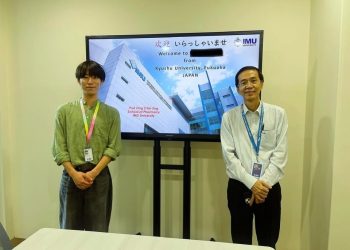
Yutaro Asaki, a fourth-year undergraduate student from the School of Pharmaceutical Sciences at Kyushu University, Japan, had the opportunity to undertake a research attachment at IMU University from 5 March to 10 May 2026. During his attachment, he was involved in a research project on CYP2W1, a cytochrome P450 enzyme expressed in certain cancers, under the supervision of Prof Ong Chin Eng and Ts Dr Tan Boon Hooi. In this interview, Yutaro shares more about his experience.
Can you introduce yourself, your university and studies in Japan?
My name is Yutaro Asaki, and I am a fourth-year undergraduate student in the School of Pharmaceutical Sciences at Kyushu University in Japan. I study pharmaceutical sciences, especially topics related to drug metabolism and enzyme function.
I conduct my research under the supervision of Prof Yuji Ishii in the Laboratory of Pharmaceutical Cell Biology. In my research laboratory in Japan, I study protein-protein interactions involving drug-metabolising enzymes such as CYPs and UGTs.
What inspired you to join this research attachment programme at IMU, Malaysia?
I was inspired to join this research attachment programme because I wanted to experience research in an international environment and broaden my perspective beyond my studies in Japan.
As a pharmaceutical sciences student, I was interested in learning
- How research is conducted in another country and
- How researchers communicate and collaborate across different backgrounds.
I also wanted to challenge myself by living and studying in a multicultural environment.
Therefore, when my professor in Japan introduced this programme to me, I immediately felt that it was an opportunity I should not miss.
Tell us more about the research project you involved in Malaysia
During my attachment at IMU, I was involved in a research project on CYP2W1, a cytochrome P450 enzyme that is expressed in some cancers. The project focuses on investigating whether selected flavonoids can inhibit CYP2W1, using both molecular docking and a luminescence-based in vitro assay.
I became interested in this field because drug-metabolising enzymes play an important role in how compounds behave in the body. I found it fascinating that enzymes such as CYP2W1 may be related not only to drug metabolism but also to cancer biology.
At this attachment, I learned how to use molecular docking software, especially Schrödinger Maestro, to predict ligand–protein interactions. I also learned more about luminescence-based enzyme assays using the P450-Glo system.
Exciting part:
One of the most exciting parts was connecting computational docking results with experimental assay design. It helped me understand how in silico and in vitro approaches can complement each other.
Challenge:
One challenge was that CYP2W1 activity was difficult to detect in the luminescence assay. At first, this was frustrating, but it taught me that unexpected results are also an important part of research. I learned how to think about possible reasons, such as enzyme activity, assay conditions, and substrate suitability.
Outside the laboratory or classroom, what activities have you enjoyed here?
Outside the laboratory, I enjoyed exploring Kuala Lumpur with local students and friends:
- Visiting famous places
- Trying Malaysian food
- Experiencing the multicultural atmosphere of the country
One unforgettable memory is the kindness of the people I met here.
My friends and supervisors (Prof Ong Chin Eng and Ts Dr Tan Boon Hooi) helped me a lot, especially when I was still getting used to life in Malaysia. Their warmth made my stay much more meaningful.


How has this mobility experience helped you grow personally or academically?
This mobility experience helped me become more independent and more confident in communicating in English. Academically, it broadened my understanding of pharmaceutical research and gave me a clearer idea of how research is conducted in different environments.
What advice would you give to other students considering an international research attachment?
My advice to other students is to take the opportunity if they have the chance.
It may feel challenging at first, but the experience will help them grow in many ways.
How do you think programmes like this strengthen global understanding and collaboration?
Programmes like this strengthen global understanding because students and researchers can learn directly from each other. By working together, we can share knowledge, respect different perspectives, and build long-term international collaboration.
We would like to extend our appreciation to Yutaro for setting aside time from his busy schedule to be part of this interview.
Thoughts Shared