


The School of Health Sciences at IMU University, in collaboration with the IMU Society of Biomedical Science (ISBS), successfully hosted the 34th Intervarsity Biochemistry Seminar (IBS) on 7 December 2024. This esteemed annual event, first established in 1986 and endorsed by the Malaysian Society for Biochemistry & Molecular Biology (MSBMB), attracted over 200 undergraduate students and faculty members from 13 public and private universities across Malaysia. The seminar provided a dynamic platform for students to present their final year research projects in biochemistry, molecular biology, and life sciences, fostering a spirit of scientific inquiry and academic excellence.
Under the theme “The Ballet of Biomolecules: Journey from DNA to Systems,” the event underscored the critical role of biochemistry and life sciences in advancing scientific knowledge. A total of 51 oral and poster presentations were delivered by dedicated undergraduate students, showcasing a wide array of research methodologies, including in silico, in vitro, and in vivo studies. The seminar also served as a networking hub, facilitating collaboration, knowledge exchange, and meaningful discussions among students, faculty, and industry professionals.
Among the standout participants, Sia Wei Tong from IMU’s Biomedical Science (BM) programme (BM1/22) won Top Oral Presenter for her research on “Melatonin-Induced Necroptosis via the RIP1/MLKL Pathway in Lung Cancer.” Supervised by Prof Dr Chye Soi Moi, Wei Tong’s study highlights the potential of melatonin as a therapeutic agent for lung cancer and provides new insights into its oncostatic mechanisms.
In the poster category, three IMU students from BM and Medical Biotechnology (MB) programmes were recognised as Top Poster Presenters:
Eng Jun Hong (BM1/22)
“Biochemical and Transcriptomic Profiling Analysis of ML125-2 Rice Mutant Line Under Reproductive Drought Stress.”
The study, supervised by Prof Dr Anna Ling Pick Kiong, found that the rice mutant line ML125-2 exhibits potential drought resistance, as evidenced by stable biochemical markers and the overexpression of stress-related and photosynthesis-enhancing genes under drought stress conditions.
Sharlane Ving Heiy Chin (MB1/22)
“Utilising Tropical Microalgae for the Phycoremediation of Diesel Hydrocarbon.”
Sharlane’s study, supervised by A/Prof Dr Wong Chiew Yen, explores the use of tropical microalgae as an eco-friendly solution for diesel hydrocarbon remediation and contributes to sustainable strategies for oil spill management and environmental restoration.
Evashiniee A/P G Panir Selvam (MB1/22)
“The Effects of Copper and Zinc on Antarctic Microalga Tritostichococcus sp. using In Vitro and In Silico Approaches.”
Evashiniee investigated the effects of heavy metal exposure on Antarctic microalgae, supervised by Dr Lim Wui Zhuan. Her study integrated laboratory experiments with computational modelling to provide insights into the tolerance mechanisms of these microorganisms, aiding environmental monitoring and climate change research.
Another participant, Kiran Adam A/L S. Mahadev (MB1/22), delivered an oral presentation titled “Optimising Dengue Vaccine Using Conserved Epitopes from Pre-Membrane Protein via Immunoinformatics” under the guidance of Dr Lim Wui Zhuan. His research employed computational approaches to identify conserved viral regions, paving the way for more effective dengue vaccine development.
Kelvin Yee Chen Ng (BM1/22), supervised by Prof Dr Chye Soi Moi, presented a poster titled “Investigation of Melatonin-Induced Necroptosis by Targeting the RIP1/MLKL Pathway in Colorectal Cancer.” His study highlights the potential of melatonin as a therapeutic agent for colorectal cancer, particularly in overcoming drug resistance through necroptosis induction.
Poster presenter Farhan Aisar Bin Mes Ewan (BM1/22), supervised by A/Prof Dr Lim Chooi Ling, presented “Photoprotective Effect of Tropical Microalgae Extracts on Ultraviolet (UV) Irradiation-Induced Damage in a Human Retinal Pigment Epithelium (RPE) Cell Line.” He concluded that Chlorella sp. and Scenedesmus quadricauda extracts exhibit photoprotective effects on UVB-irradiated ARPE-19 cells, highlighting their potential as a novel approach for age-related macular degeneration treatment.
These achievements reflect the dedication, hard work, and innovative thinking of IMU’s BM and MB students, along with their supervisors. Their research not only contributes to the advancement of biotechnology and medical sciences but also reinforces IMU’s commitment to nurturing future leaders in scientific discovery.
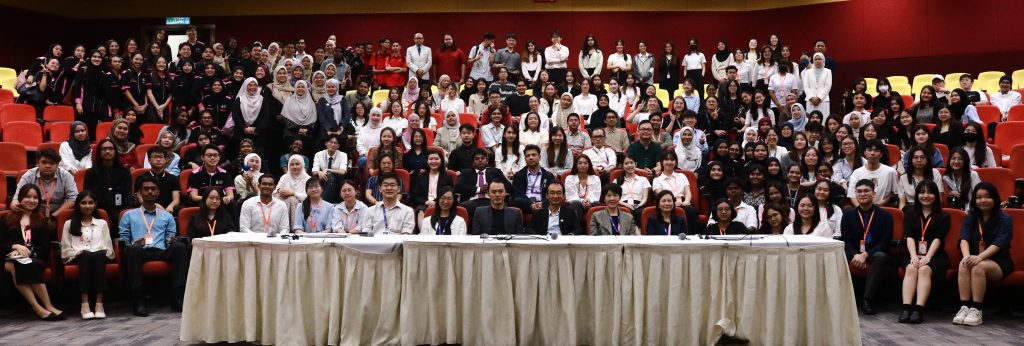
The 34th IBS not only celebrated the achievements of young researchers but also highlighted the importance of interdisciplinary collaboration in addressing complex scientific challenges. By hosting the event, IMU University reinforced its commitment to driving scientific innovation and nurturing the next generation of researchers poised to make significant contributions to the life sciences industry.
Submitted by A/Prof Kok Yih Yih and Dr Yeannie Yap Hui Yeng (IMU Lecturers) and Willem Tan B Jay (IMU Biomedical Science Student from cohort BM123)
Thoughts Shared