


Immersive learning refers to educational experiences that engage students in a highly interactive and participatory manner, often utilising technology and real-world simulations to create realistic scenarios. This educational approach is particularly beneficial in fields such as nursing, where practical skills, critical thinking, and problems solving are imperative. Immersive studios not only allow students to simulate clinical procedures and decision-making without risk to real patients, enhancing problem-solving and adaptability (Liu et al., 2024), it enhances knowledge retention, strengthen clinical confidence, and promote reflective learning through real-time feedback (Chang et al., 2024; Choi et al., 2022).
In May 2025, we introduced immersive studio-based sessions for the IMU nursing cohort NU124, focusing on wound dressing and suture removal technique. Students were divided into 3 groups with 9-10 students to each group. While one group engaged in a 30-minute immersive session, others practiced in an open ward. Students first observed a “show and tell” and full procedural demonstration on a manikin. During the immersive session, they interacted with blinking tabs revealing step-by-step instructions based on simulated cases, answered scenario-based questions, and completed quizzes. This was followed by a hands-on skill demonstration, with peer and faculty feedback provided to reinforce learning.
Post-immersion survey with 89% response rate showed that 52% of students rated the experience as good to excellent, with 88% agreeing it enhanced engagement, collaboration, and critical thinking. Students praised the realism and interactivity of the sessions, which helped them connect theory to clinical practice and improve memory retention and situational awareness.
Challenges identified included large group sizes limiting hands-on opportunities and occasional technical glitches. Students recommended smaller groups and system improvements to maximise learning effectiveness.
The implementation of immersive studio-based learning for the NU124 nursing cohort marked a meaningful move in adopting innovative, student-centered clinical education. It is not aimed to replace the traditional teaching and learning methods but rather serve as a complimentary in nursing education.
Overall, the immersive studio approach was well-received, effectively bridging classroom learning with practicum application. Although immersive learning enhances engagement and conceptual understanding, it should be supported by more frequent hands-on practicums, smaller group sessions, and consistent reinforcement of clinical skills to strengthen overall competence and readiness for practice.
Acknowledgements
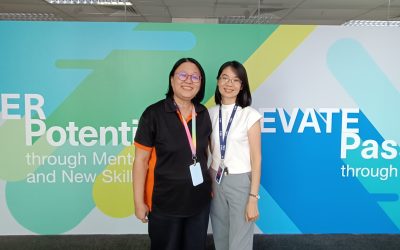
The development of the immersive studio for the suture-to-open (STO) was led by Dr Chang Woan Ching (author), with valuable support from the nursing and Clinical Simulation and Skills Centre (CSSC) members. The scene backgrounds used were adapted from designs created by the CSSC team. Special thanks are extended to Ms Deepa A/P Kaliappen and Ms Lee Mei Ying for their assistance with video recording and photography of the procedure and practicum sessions. Technical support was provided by Mr Dharshan Kumar A/L Kumarasan, while content review was done by Dr Lim Swee Geok (left in the photo on the right). The immersive studio for wound dressing was adopted from CSSC team. The author gratefully acknowledges the contributions, collaboration, and expertise of all staff involved in supporting the successful implementation of the immersive studio.
References:
Chang, Y.Y., Chao, L.F., Chang, W., Lin, C.M., Lee, Y.H., Latimer, A., & Chung, M.L. (2024). Impact of an immersive virtual reality simulator education program on nursing students’ intravenous injection administration: A mixed methods study. Nurse Education Today, 132 (), https://doi.org/10.1016/j.nedt.2023.106002.
Choi, J., Thompson, C.E., Waddill, C.B., & Choi, S. (2022). Effectiveness of immersive virtual reality in nursing education: systematic review. Nurse Education, 47 (3). doi: 10.1097/NNE.0000000000001117
Liu, J.Y.W., Mak, P.Y., Chan, K., Cheung, D.S.K., Cheung, K., Fong, K.N.K., Kor, P.P.K., Lai, T.K.H., & Maximo, T. (2024). The effects of immersive virtual reality–assisted experiential learning on enhancing empathy in undergraduate health care students toward older adults with cognitive impairment: Multiple-methods study. JMIR Med Educ, 10. https://preprints.jmir.org/preprint/48566
Written by Dr Chang Woan Ching, Senior Lecturer, Nursing Division, School of Health Sciences, IMU University
Thoughts Shared