


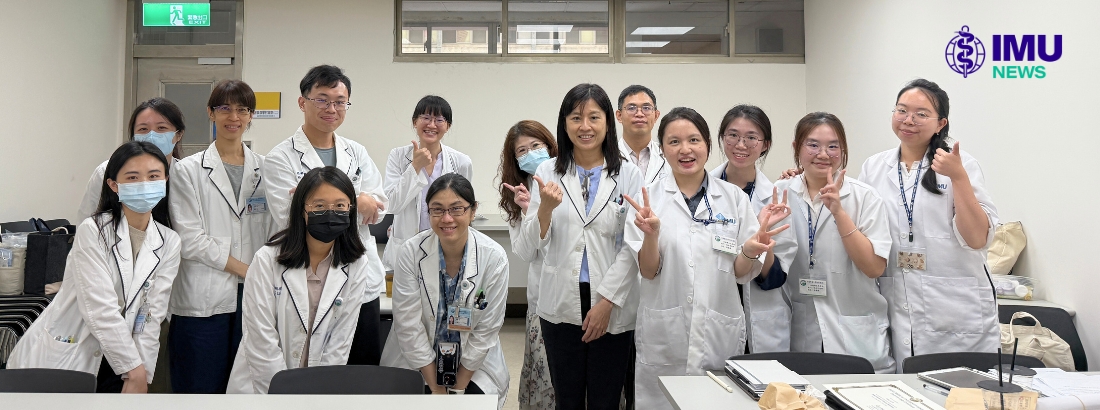
In May 2025, four final-year Dietetics with Nutrition students from IMU University—embarked on a one-month clinical placement at China Medical University Hospital in Taiwan. It was an entirely new experience for them, as Taiwan’s culture and language differ greatly from their usual placement sites in Malaysia. This unfamiliar environment made them both excited and slightly apprehensive, as they prepared to explore clinical dietetic practices beyond their home country. This article shares their experience during the placement.
Final-year Dietetics with Nutrition Students in this Placement
Lieu Li Yi
Delanie Hue Le Ting
Ong Huay Xin
Wee Yi Wen
Hands-on Experience
Throughout this enriching attachment in Taiwan, we had the opportunity to gain hands-on experience and observe various aspects of hospital food service and dietetics practice. From clinical nutrition exposure to behind-the-scenes food preparation, the experience provided a well-rounded understanding of how dietary care is delivered in a healthcare setting.
In the Food Service Department, we engaged in a wide range of tasks—from preparing vegetables and drinks to plating meals for different wards, including children, pregnant women, and VIP patients. We observed meticulous hygiene practices, efficient workflow, and advanced equipment, including tray lines, conveyor belts, and sterilization systems. Quality control procedures, such as pesticide testing on vegetables every day, further highlighted the hospital’s commitment to food safety.
The hospital food service system in Taiwan is well-structured, efficient, and highly patient-centered. Meals are tailored to meet individual dietary needs, including normal, texture-modified (minced, pureed), and various therapeutic diets (e.g., low potassium, low cholesterol, high salt). A 15-day rotating menu features both Chinese and Western dishes, with festive meals specially prepared for cultural occasions.
Oral Nutrition Supplements (ONS) are also provided based on medical conditions, including tailored options for diabetes, chronic kidney disease, and patients requiring hydrolyzed formulas. Beyond inpatient meals, the kitchen staff also prepares bento lunch sets for retail, reflecting both versatility and high service standards.
Regarding clinical nutrition exposure, we had the opportunity to observe the nutrition care process under several dietitians across 21 different inpatient wards, including the Burn ward, neonatal ICU ward, hospice ward, neurosurgery ICU ward, and the outpatient setting. A computerised bedhead ticket system was implemented in the hospital, allowing a more efficient nutritional assessment of the patients. We were given cases to clerk daily, followed by discussions with the dietitians on the cases as well as the chance to observe the nutritional interviewing between the dietitians and patients. In light of the clinical exposures, we were individually assigned to present a case report and journal article report to showcase our learnings throughout the placement.
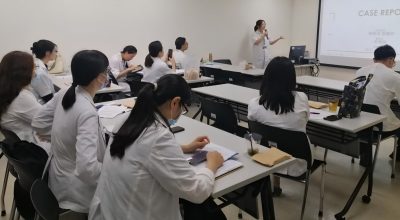
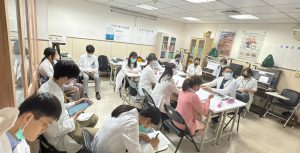
Besides, the hospital has a strong emphasis on having a multidisciplinary medical team. Hence, ward rounds would involve doctors, nurses, pharmacists, dietitians, physiotherapists etc to provide their input and receive suggestions from one another to achieve the best patient care. There are also multidisciplinary meetings that happen on a regular basis where personnel such as social workers and religious workers may also be involved to provide a more holistic approach to patient care. We had the chance to observe both modes of multidisciplinary efforts of the hospital.
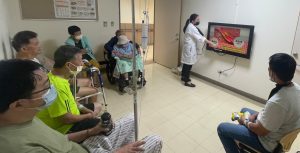
Other than that, the clinical nutrition department also offers nutrition education to patients in a 1 on 1 setting or group setting. We were each in charge of providing nutrition education for different groups of patients during our placement.
It was a completely new and eye-opening experience for us to work as student dietitians in a different country. As expected, we encountered several challenges throughout the placement.
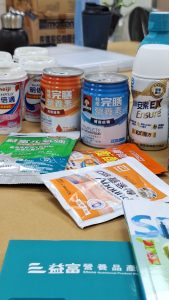
First and foremost, we needed to familiarise ourselves with the various brands of oral nutrition supplements (ONS) commonly used in Taiwan, along with their specific functions and suitability for different disease conditions.
Gaining this additional knowledge allowed us to broaden our understanding of ONS and apply what we learned to meet the specific nutritional needs of different patients more effectively.
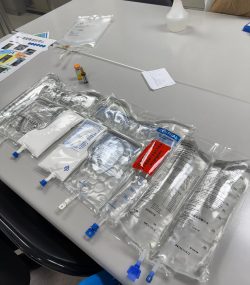
Next, one of the most significant challenges we faced was prescribing total parenteral nutrition (TPN) regimes. This was particularly difficult for us because we had limited hands-on training in Malaysia and were not fully familiar with the composition, saturation, and types of TPN used in Taiwan.
The lack of prior exposure made it difficult to confidently develop TPN prescriptions that were both appropriate and effective.
Thankfully, the dietitians gave us substantial guidance and support, not only did they teach us the proper methods for calculating TPN formulations but they also provided detailed and constructive feedback on our proposed regimens, addressing important aspects such as the saturation level of the TPN solution and the appropriate route of administration based on the patient’s clinical condition.
Furthermore, the dietitians gave us exercises that required us to identify the roles and therapeutic purposes of each component within the TPN bag, helping us understand how these elements could be tailored and applied effectively to meet the specific nutritional needs associated with various disease conditions.
Another challenge we encountered was the language barrier. Most of the medical terminology and case discussions were conducted in Mandarin, which we were not fully familiar with. This made it harder to follow clinical reasoning or understand patient charts at times.
Fortunately, the dietitians were understanding and would verbalize the English terminology to help in our learning. They would also slow down their pacing and break things down so that we can better understand the explanations. During ward rounds, the doctors would translate terminologies into English, helping us to keep track with the discussion. We would also actively look up unfamiliar Mandarin terms while we clerked cases and worked on our assignments. Hence, this challenge proved to be a valuable learning opportunity, as we gradually became more familiar with commonly used medical terms in Mandarin, thereby expanding our vocabulary and enhancing our communication skills. This will be helpful if we plan to venture into a Mandarin-speaking working environment or will be facing Mandarin-speaking clients and patients.
Hence, despite the challenges, the experience was immensely rewarding. The seniors and supervisors at the placement site were very friendly, patient, and always willing to teach and support us. Their guidance helped us grow both professionally and personally. Overall, this international placement not only enriched our clinical knowledge but also enhanced our adaptability, communication, and problem-solving skills that will be useful in our future careers.
A Deeply Enriching Experience
Our time at China Medical University Hospital was deeply enriching. It broadened our perspectives and helped us appreciate how cultural context shapes dietetic practices to better serve patients’ needs. This placement not only encouraged us to think beyond conventional approaches, but also inspired us to develop creative, patient-centered solutions we hadn’t previously considered. It opened our eyes to the vast potential for innovation and growth within the field of dietetics.
Looking back, we recognise how our prior clinical placements in Malaysia had built a solid foundation for us that strengthened our clinical judgement and reasoning. The prior training – particularly in independently conducting nutrition assessments to nutrition monitoring and evaluation – helped us to be sharper in our clinical judgement. It equipped us to identify nutritional issues effectively even in a different language, documentation, and care system. Moreover, the training in fast-paced hospitals has trained us to be vigilant, observant and efficient in our clinical conduct and communication during our placement in Taiwan. Our experience and learnings in Taiwan would have not been possible without the training and guidance of our clinical educators in Malaysia.
We are deeply grateful for the invaluable learning opportunities and exposure provided by IMU Dietetics with Nutrition programme and the support of IMU Mobility Funding, where we engaged in inspirational, transformative clinical placement. The hands-on experiences and insightful knowledge at this placement site not only enhanced our practical skills and professional growth but also inspired us to lifelong learning as future-to-be dietitians.
Thoughts Shared