


Article Summary
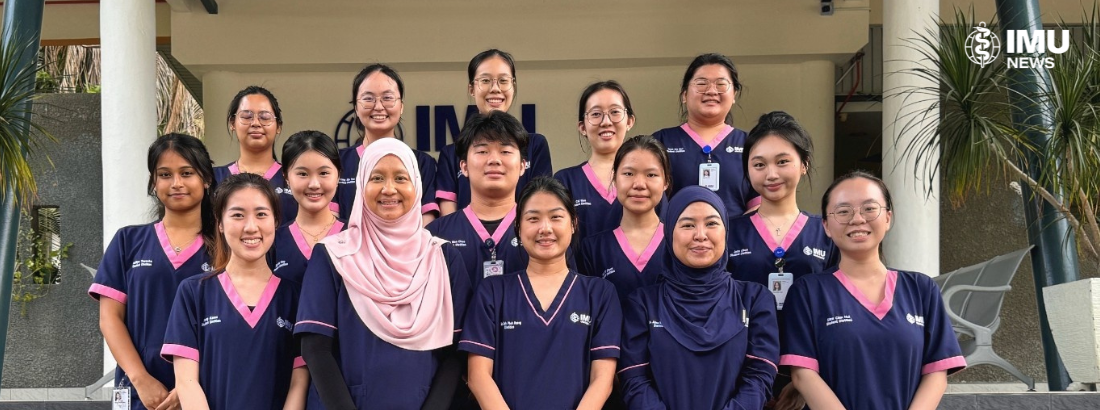
The Student Dietetics Centre (SDC) serves as a student-led healthcare initiative that supports community nutrition services while providing final-year dietetics students with hands-on experience in healthcare operations, quality assurance, and community health promotion.
Key Contributions
- Supported dietetic consultation and community nutrition services.
- Developed 11 new nutrition education resources and updated three existing materials.
- Assisted with teleconsultation and digital health initiatives.
- Conducted quality assurance activities to improve service delivery.
- Managed outreach, stakeholder engagement, and health promotion activities.
- Strengthened student competencies in leadership, teamwork, communication, and operational management.
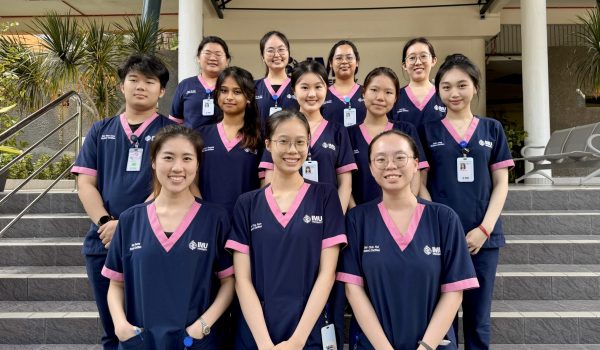
IMU Dietetics with Nutrition Students in this Learning Activity
- How Xing Xuan
- Kang Karen
- Siaw Chin Hui
- Han Wen Chou
- Teoh Xin Mei
- Kaitlyn Ann Theseira
- Chia Cai Wen
- Tharine Jyo Liyn
- Wong Xin Yue
- Chua Wen Yuie
- Glynis Kay Lin Xin
- How Yi Shyen
Overview of Student Dietetics Centre (SDC)
The IMU Student Dietetics Centre (SDC), established in 2023, provides dietetic consultation and anthropometric assessment services to the community while serving as a vital platform for final-year Dietetics with Nutrition students to expand their clinical and community experience. Over time, through the collective efforts of both staff and the student committee, SDC has grown and evolved.
This growth would not have been possible without the strong foundation laid by previous committees and the continuous dedication of the staff committee.
In particular, the DN119 cohort played a pioneering role as the initial project team in establishing the SDC alongside the staff committee, contributing significantly to the setup and early operations of the centre.
Building on this foundation, the SDC Student Committee, comprising final-year dietetics students, continues to lead the centre’s operations with guidance from the staff team.
As the DN122 cohort who witnessed key transitions including handover, relocation, and rebranding, we recognised that the student committee not merely as an organising body, but as the backbone of SDC in delivering its services to the community.
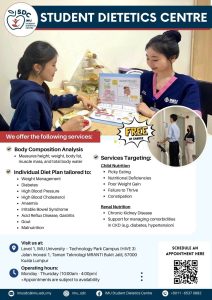
To support its success and ensure smooth workflow, SDC operates as a student-led initiative structured into key departments, including Centre Operations, Administrative, Resource Management, Finance, Quality Assurance and Research, as well as Outreach and Communications, all under the guidance of the staff committee.
Our involvement in these roles allowed us to gain meaningful exposure to the non-clinical competencies required in dietetics practice, including
- Coordination
- Teamwork
- Operational Management
Leading the Operations: Ideate, Communicate and Unite
Being part of the Centre Operations team allowed us to support the workflow within SDC through ideating, communicating and coordinating with both internal teams and external stakeholders.
A key experience was the planning of the Art of Culinary Medicine cooking workshop series, from brainstorming ideas to proposal development. We also helped compile the annual SDC report, bringing together the centre’s activities and achievements into one summary. These tasks required us to communicate across teams and align different inputs towards a common direction.
Through this, we realised that operations work is not just about coordination, but about connecting ideas, people and efforts to make things happen.
As future dietitians, this experience reflects how teamwork and communication are essential in real healthcare and community settings, where collaboration shapes the success of programmes and care delivery.
Behind the Scenes: Driving Efficiency and Integrity in Operations
As members of the Administration team, we gained firsthand experience in the operational processes that keep the SDC running smoothly. From managing patient registrations and appointments to maintaining accurate records, we learned how attention to detail and organised workflows contribute directly to service quality and continuity of care.
Collaborating with the Research and Quality Assurance teams also strengthened our understanding of data integrity, confidentiality, and the importance of adhering to PDPA requirements in healthcare settings.
We were also involved in
- monitoring patient load trends,
- identifying scheduling gaps, and
- preparing reports to improve workflow efficiency.
These tasks helped us develop stronger communication, teamwork, and problem-solving skills while navigating real-time coordination challenges.
Through this experience, we realised that administrative work is not just backend support, but it is a critical component of delivering safe and efficient patient care.
One of the most valuable experiences was supporting the centre’s digitalisation and teleconsultation initiatives. Adapting to these digital systems challenged us to be flexible and solution-oriented, particularly when managing technical issues and ensuring smooth communication between clients and student dietitians.
These experiences strengthened our problem-solving and adaptability, which are essential in modern healthcare settings where digital health services are increasingly integrated into patient care.
Overall, our role in administration extended beyond backend support; it provided us with practical insight into the operational backbone of a healthcare service.
As future dietitians, this experience enhanced our understanding of how effective coordination, accurate documentation, and data management contribute to safe, efficient, and patient-centred care.
From Development to Delivery: Equipping the SDC for Success
The Resources team played a key role in expanding SDC’s educational materials and tools to support both client education and programme delivery.
Over the term, we developed 11 new resources, including a prediabetes pamphlet, a haemodialysis flipchart, end-stage renal failure pamphlets, muscle-building pamphlet, food exchange guides booklet etc.
In addition, three existing flipcharts were updated for clinical accuracy, bringing the total of newly added or refreshed materials to 14 items, all formally integrated into the SDC resource repository.
Through close coordination with clinical educators (CEs), we learned the importance of developing diet-related education resources that are not only evidence-based but also practical, accessible, and suitable for diverse patient populations. These materials were prepared specifically for client use and nutrition workshops at community settings.
Beyond content development, we actively supported workshop content and centre aids by providing essential items for events, such as educational pamphlets, screening tools, food models, plates, and eating utensils for hands-on demonstrations.
Through these experiences, we developed stronger skills in organisation, evidence-based practice, and resource planning. More importantly, this role allowed us to appreciate how educational resources directly influence the quality and effectiveness of nutrition counselling and delivery.
Maintaining Standards: Ensuring Quality and Continuous Improvement in SDC
The Quality Assurance team plays a key role in monitoring the quality of services delivered by student dietitians and ensuring standardised care within SDC. Throughout the term, collected feedback is analysed to identify trends and areas for improvement, ensuring a consistent and positive delivery of care while supporting the continuous refinement of services within the centre.
In addition, the team ensures adherence to established guidelines and best practices across all SDC activities. This includes
- Evaluating consultations
- Assessing the effectiveness of educational materials
- Ensuring that the programme implementations align with evidence-based recommendations and meet patient needs
These efforts support SDC in maintaining credibility while delivering safe, accurate, and high-quality nutrition care.
Feedback is gathered not only from patients but also from students to evaluate the centre’s effectiveness as a learning environment. Constructive input from students provides valuable insights for clinical instructors (CIs), helping them better guide student learning and identify areas where additional support may be needed within SDC.
Through these responsibilities, members of the Quality Assurance team develop key skills such as critical thinking, attention to detail, and evaluation skills, which are essential for assessing quality and driving improvements in healthcare service delivery.
Enhancing Public Outreach: Connect, Communicate, and Collaborate
The Public Outreach (PO) team focuses on increasing SDC’s visibility and building collaborations with both internal and external stakeholders. Our responsibilities included
- Managing social media platforms,
- Creating educational and promotional content aligned with Medical Nutrition Therapy (MNT) guidelines, and
- Utilising digital communication channels such as email and WhatsApp to enhance SDC’s outreach efforts.
We also monitored engagement metrics and analysed outreach effectiveness to inform and improve future communication strategies.
In addition, we were involved in
- Developing partnerships with stakeholders,
- Supporting collaborative initiatives,
- Facilitating referral opportunities, and
- Coordinating promotional and communication activities.
Through these experiences, we gained valuable insights into the importance of strategic communication and stakeholder engagement in promoting healthcare services. This allowed us to develop stronger leadership, public speaking, and community engagement skills while learning how effective outreach can influence patient awareness and participation.
As PO members, this experience helped us recognise the important role that outreach and communication play in supporting dietetics services. We learned that increasing awareness, fostering stakeholder relationships, and delivering clear, evidence-based messages are essential for improving engagement with nutrition-related programmes and services.
Through coordinating promotional activities and collaborations, we gained a better understanding of how effective communication can influence participation, accessibility, and the overall reach of dietetics initiatives. These experiences reflect real-world practice, where strong outreach efforts are crucial in connecting communities with nutrition services and ensuring that health promotion messages reach the intended audience.
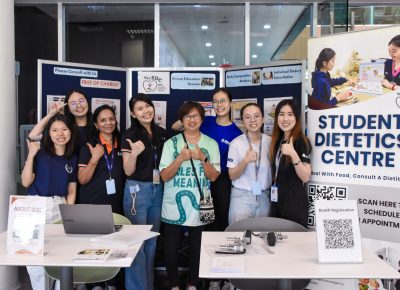
Conclusion: Playing a Significant Role in Community Health and Student Development
Overall, SDC continues to play a significant role in supporting both community health and student development. Being part of the student committee across various departments has provided valuable exposure to real-life operational management, enhancing skills in multitasking, teamwork, and leadership that are essential for future professional practice.
We extend our appreciation to the staff committee for their continuous guidance and support, as well as to all team members for their collaboration and commitment. Moving forward, we look forward to the continued growth of SDC and the development of more impactful initiatives that further strengthen both student learning and community engagement.
Thoughts Shared