

ICE advocates faculty development to ensure consistency of students’ learning experience based on the university’s learning model and to meet the changing needs of health care services.
Over 70 faculty development programmes (FDP) are conducted annually exclusively for IMU faculty members, ranging from workshops, webinars, plenaries, expert clinic sessions, forums and HPE journal club. The sessions are facilitated by both IMU experts and visiting professors, mainly from IMU’s partner schools. Additionally, the Visiting Professorship Programmes at IMU University enable renowned experts in health professions education to share their expertise in various topic for the faculty to apply it in the regional context. In addition, these experts work collboratively with experts within IMU to facilitate hands-on workshops in various aspects of health professions education.

Roles of Faculty Members
FDP are developed and designed based on Faculty Competency Assessment Tool (Fac-CAT). The FDP offered are mapped to the 8 roles of faculty members based on Fac-CAT.
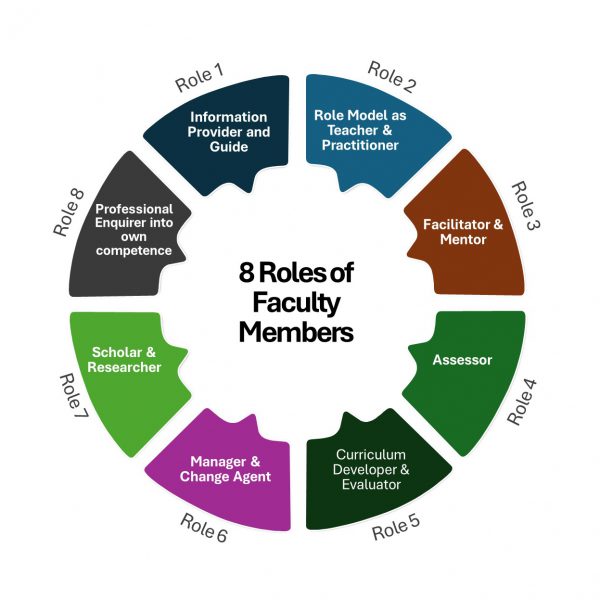
Role 1 – Information Provider and Guide
Role 2 – Role Model as Teacher & Practitioner
Role 3 – Facilitator & Mentor
Role 4 – Assessor
Role 5 – Curriculum Developer & Evaluator
Role 6 – Manager & Change Agent
Role 7 – Scholar & Researcher
Role 8 – Professional Enquirer into Own Competence
ICE’s Faculty Development Activities
ICE’s faculty development activities are categorised as follow:









Workshops Offered Upon Request
We also offer the workshops below upon request for IMU University’s faculty members, departments, or schools to address specific academic or professional development needs.
Workshop content, format, and duration can be tailored according to institutional priorities and participant profiles. Workshops are offered subject to identified need and resource availability. To request a workshop, please write to us with the proposed topic, target participants, preferred dates, and preferred mode of delivery. Our team will review the request and follow up accordingly.
- Learning through reflection: The use of portfolios in health professions education
- Principles of assessment
- Quality assurance of assessment: Test and Item Analysis, Standard Setting for Written Tests
- Construction of written test items
- Designing Higher Order Thinking MCQ (OBA & EMQ)
- Practical considerations and standard setting for open-book exams
- An Introduction to Psychometric Analysis of OBE
- Readiness For Entrustable Professional Activities (EPA) Implementation
- Micro-credential Development
- OSCE Station Writing
- Understanding Table 4 & Blueprinting
- Peer Observation of Teaching