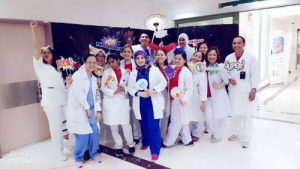
Collaborating with esteemed consultants who valued nurses’ input in patient care decisions added joy to my responsibilities.
During my tenure in Saudi Arabia, I gained a distinctive perspective on pediatric cardiac cases, notably those involving Tetralogy of Fallot (TOF), commonly referred to as the “Blue Baby” condition. This congenital heart defect involves four distinct abnormalities, leading to insufficient oxygenation of the blood. The sight of patients exhibiting a bluish hue throughout their bodies due to oxygen saturation levels as low as 70% to 75% has profoundly influenced my medical journey.
Encountering cases where the heart was situated on the right side of the chest added a layer of complexity to my comprehension of cardiac anatomy. This anomaly, known as dextrocardia, challenges conventional expectations and emphasizes the intricate variations possible in the development of the human heart. Observing such cases underscored the need for a comprehensive and adaptable approach to medical care, particularly within the dynamic realm of pediatric cardiology.
Moreover, my experiences exposed me to instances where the heart was located outside the body, an exceedingly rare condition termed ectopia cordis. This anomaly occurs when the developing fetal heart fails to properly move into the chest cavity during embryonic development. Managing and treating such cases requires a collaborative effort from a multidisciplinary team of specialists, including pediatric cardiologists, surgeons, and neonatologists, ensuring the most favorable outcomes for these fragile patients.
These encounters not only deepened my understanding of congenital heart conditions but also highlighted the significance of cultural sensitivity in healthcare delivery. Working in Saudi Arabia provided a unique cross-cultural experience, enabling me to grasp the intersection of medical expertise and cultural difference when addressing the healthcare needs of various populations. Facing these difficult cases, I found inspiration in the adaptability demonstrated by both patients and their families. Working closely with colleagues across different specialties promoted a well-rounded approach to patient care, emphasizing that tackling complicated medical conditions demands a thorough and cooperative effort. The pattern of my experiences in Saudi Arabia, woven with these unique cardiac cases, has not only expanded my medical knowledge but has also instilled in me a profound appreciation for the complicities of the human body and the resilience of individuals facing extraordinary health challenges.
My experience as a Malaysian nurse in Saudi Arabia has been a blend of challenges and successes, marked by lessons and experiences that influenced my career and enhanced my life. It serves as proof of how strong people can be and the importance of staying determined when faced with uncertainty. Throughout this journey, I not only grew as a more skilled nurse but also built lasting connections with colleagues from different parts of the world. This experience deepened my understanding and appreciation for the diverse richness that comes with cultural exchange.
In conclusion, my journey from Malaysia to Saudi Arabia has not only forged me into a more strong and culturally aware healthcare professional but has also gifted me a strongest match of experiences and insights that significantly contribute to my current role as a Clinical Instructor. The puzzle of challenges and success pathway into my time in a foreign land now forms the solid foundation for passing on my practical knowledge, nurturing cultural competence, and motivating the next generation of nursing students at the International Medical University. Through this journey, I infuse a global perspective into clinical practices, emphasizing to my students the most importance of adaptability, empathy, and an unwavering commitment to excellence in the ever-evolving realm of nursing in healthcare professions.
%202024.png)