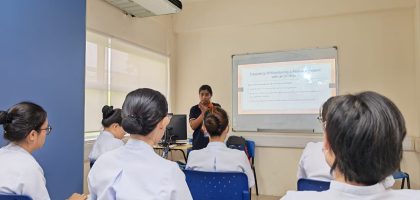
The classroom then gave way to the clinical lab, where facilitators, led by me and supported by Ms Lee Mei Ying, brought the theory to life. Through live demonstrations, they showcased safe pump setup, programming, and troubleshooting using advanced simulation tools that mimicked real hospital wards. The students watched closely, then rolled up their sleeves and stepped into the role themselves.
In hands-on practice sessions, guided by the Direct Observation of Procedural Skills (DOPS) framework, students rotated through stations where they could handle pumps independently. Mistakes were not punished but treated as opportunities for learning. In this safe environment, every student found the confidence to take control of the equipment, sharpen their critical thinking, and practise with the reassurance of experienced facilitators by their side. Each session closed with reflection, post-tests, and open discussions, ensuring that knowledge was not only gained but deeply reinforced.
This was not merely a teaching exercise—it was a carefully designed, evidence-based approach, informed by global best practices in nursing education. Research has long confirmed the value of simulation in nursing: Li et al. (2021) and Nakamura et al. (2023) demonstrated that simulation training enhances both clinical precision and decision-making, while Gomes and Tan (2020) highlighted that real-time feedback during infusion pump training reduces anxiety among novice nurses.
By aligning with such findings, as well as with the Malaysian Nursing Board’s competency standards, which require nursing graduates to demonstrate identified competencies and meet registration criteria (Ministry of Health Malaysia, 2013), and the WHO’s Medication Without Harm global patient safety framework, which aims to reduce avoidable medication-related harm through strategies targeting high-risk situations, polypharmacy, and transitions of care (World Health Organization, 2017), the IMU workshop ensured that students were trained to meet both local and international standards of safety.
%202024.png)