%202024.png)


17 October 2025 | IMU University
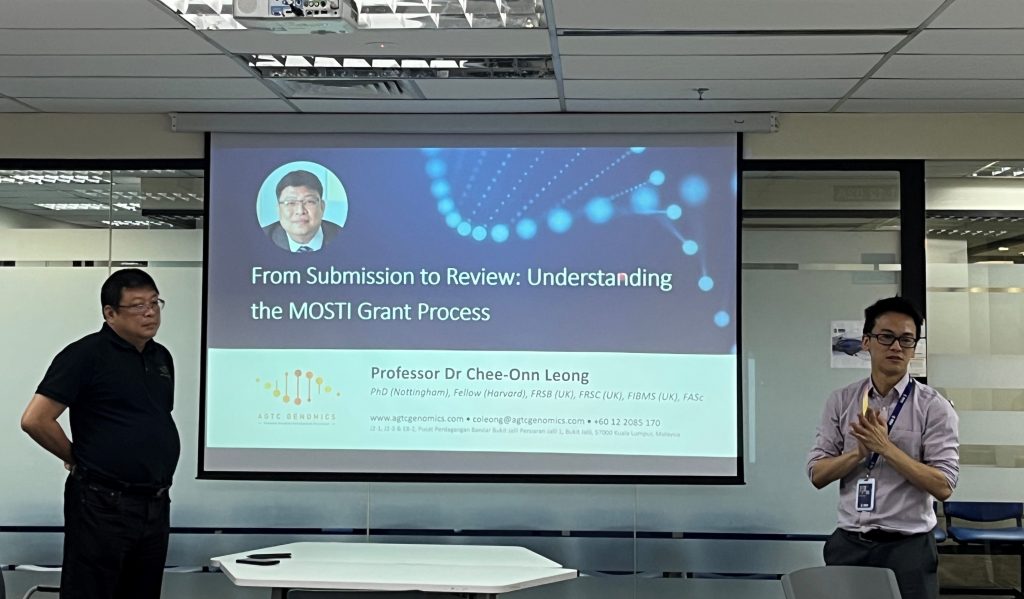
On 17 October 2025 (Friday), the Institute for Research, Development and Innovation (IRDI) successfully hosted the fourth instalment of its flagship series, MIND (Meet, Inspire, Network & Discuss), at IMU Bukit Jalil Main Campus (PBL1.12.02 ABC). The session featured Dr Leong Chee-Onn, a distinguished cancer biologist, genomics researcher, and experienced grant reviewer, as the invited speaker for the talk titled “From Submission to Review: Understanding the MOSTI Grant Process.”
Dr Leong obtained his Bachelor’s Degree in Biomedical Sciences (Honours) from Universiti Putra Malaysia and a PhD from the University of Nottingham, United Kingdom. He has previously served as Senior Research Fellow at Harvard Medical School and Massachusetts General Hospital, USA. Currently, he is the Chief Executive Officer of AGTC Genomics, leading translational genomics innovations in precision medicine. He is also a Fellow of the Royal Society of Biology (FRSB, UK), the Royal Society of Chemistry (FRSC, UK), and the Institute of Biomedical Sciences (FIBMS, UK), Academy of Sciences Malaysia (FASc). In addition, Dr Leong contributes to national science policy as a member of the MOSTI Strategic Research Fund and Technical Committee, under the Ministry of Science, Technology and Innovation (MOSTI), and serves on the Faculty External Advisory Panel (FEAP) at the University of Nottingham Malaysia.
During his engaging 1.5-hour session, Dr Leong provided a comprehensive overview of the Ministry of Science, Technology and Innovation (MOSTI) funding ecosystem. He explained the objectives of various funding schemes, including the Applied Innovation Fund (AIF), Technology Development Funds (TeD1 and TeD2), Bridging Fund (BRG), and Strategic Research Fund (SRF-RFP), which support projects from early prototype development to commercialisation. He emphasized that proposals should demonstrate translational or applied value.
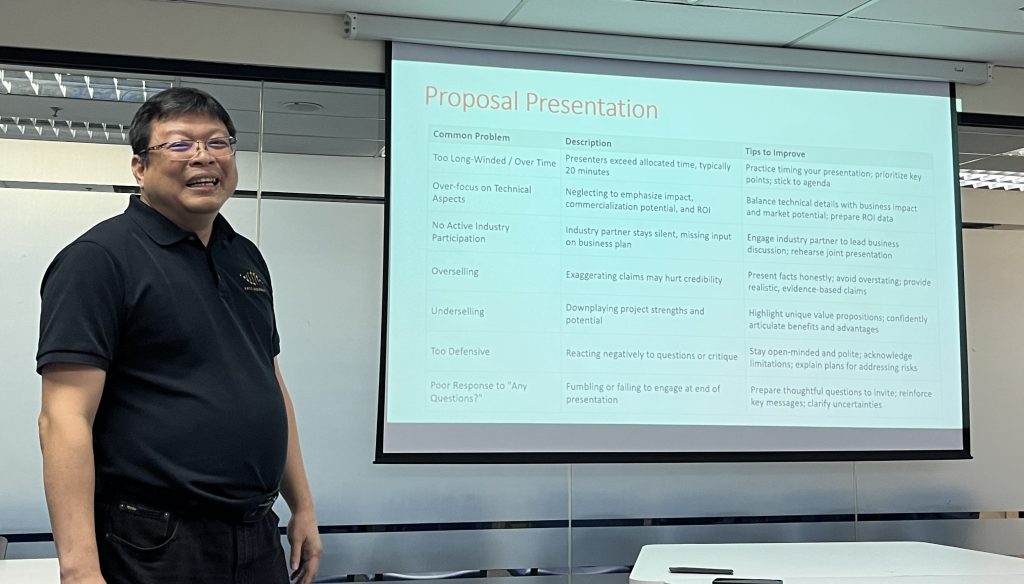
He highlighted the importance of understanding Technology Readiness Levels (TRLs), which indicate a project’s stage of development from concept (Level 1) to market readiness (Level 9). Providing concrete evidence to justify the claimed TRL is essential, as it reflects a project’s maturity and commercial potential. or medical and diagnostic research, the modified TRL system aligns TRL 5–7 with Phase I–III clinical trials. Dr Leong then offered step-by-step advice on the MOSTI grant application process. Concluding his talk, he shared practical pitching tips, including managing time well, being transparent, and balanced confidence with realistic expectations to align with MOSTI’s translational research goals.